

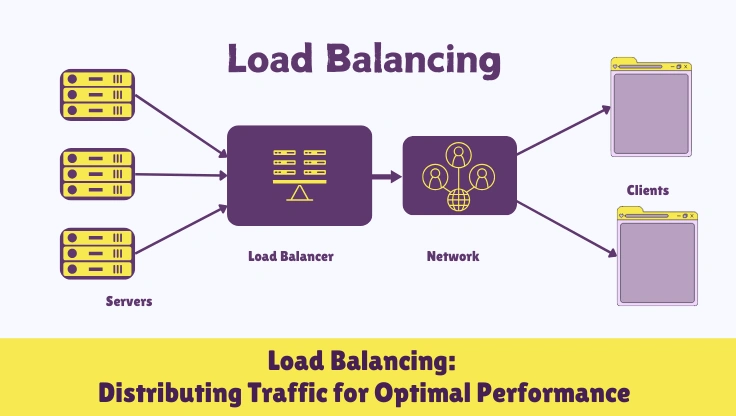
Load balancing gets mentioned as a premium hosting feature, and for large-traffic or high-availability applications it is a genuinely important piece of infrastructure. For the overwhelming majority of websites, it solves a problem they do not actually have yet. Understanding what it does, and how the underlying algorithms differ, makes it clear when it is worth the added complexity and when it is not.
The Two Problems Load Balancing Solves
Load balancing exists to address two related but distinct problems. The first is capacity: a single server has a hard ceiling on how much traffic it can handle, determined by its CPU, RAM, and how efficiently the application uses them. Once traffic exceeds what one server can process with acceptable response times, the options are to make that one server bigger (vertical scaling, upgrading to more CPU and RAM) or to add more servers and distribute the load across them (horizontal scaling), which is where a load balancer becomes necessary, something has to decide which server handles each incoming request.
The second problem is availability. A single server is a single point of failure, if it goes down (hardware failure, an operating system crash, a deployment that breaks something), the site goes down with it, with no fallback. A load balancer distributing traffic across multiple servers, combined with health checks that detect a failed server and stop routing to it automatically, means a single server failing does not take the whole site down, traffic simply continues flowing to the remaining healthy servers while the failed one is repaired or replaced. For businesses where downtime has direct financial cost, this availability benefit alone can justify load balancing even at traffic levels a single server could technically still handle.
The Distribution Algorithms Explained
How a load balancer decides which backend server gets each request is not a single, fixed method, different algorithms suit different traffic patterns:
Round-robin cycles through servers in fixed order, request one to server A, request two to server B, request three to server C, request four back to server A. It is simple and works acceptably when servers have equal capacity and requests take roughly similar processing time. Its weakness is that it has no awareness of how busy any server currently is, if server A happens to be in the middle of a slow request, round-robin will still send it the next request purely because it is A's turn, potentially overloading an already-struggling server.
Least-connections tracks how many active connections each backend server currently has open and routes each new request to whichever server has the fewest. This adapts naturally to uneven request costs, a server working through several slow requests accumulates connections and receives fewer new ones until it catches up, while a server that just finished quickly is favored for the next request. For most real-world web traffic, where request processing time varies meaningfully (a cached page versus an uncached database query, a simple page view versus a checkout process), least-connections distributes load more evenly in practice than round-robin's blind rotation.
IP-hash computes a hash of the visitor's IP address and uses it to consistently assign that visitor to the same backend server for their entire session. This solves a specific problem round-robin and least-connections do not address: applications that store session data (a shopping cart, login state) locally on whichever server first handled that visitor, without a shared, centralized session store. If a visitor's second request lands on a different server that has no record of their session, the application breaks in ways ranging from being logged out unexpectedly to losing cart contents. IP-hash trades some load-distribution evenness for session consistency, which is the right tradeoff for applications not built with centralized session storage.
Sticky Sessions: Solving the Same Problem a Different Way
Sticky sessions (session affinity) describes the broader goal IP-hash serves, keeping a visitor consistently routed to the same server, achieved through a different, often more reliable mechanism in modern load balancers: a cookie. On a visitor's first request, the load balancer sets a cookie identifying which backend server handled it. On every subsequent request, the load balancer reads that cookie and routes to the same server accordingly.
This is more reliable than IP-hash in one specific, increasingly common scenario: visitors behind a shared or rotating IP address, common on mobile carrier networks (which frequently use carrier-grade NAT, meaning many different phones share few public IPs) and corporate networks. IP-hash in this situation can misroute or inconsistently route visitors whose apparent IP changes or is shared with unrelated users. A cookie-based approach ties the session to the visitor's browser specifically, independent of what their IP happens to be at any given moment, which is why it has become the more common implementation in modern load balancing products even though the underlying goal is identical to what IP-hash was originally designed to achieve.
What Load Balancing Actually Requires Beyond the Load Balancer
The load balancer itself is only one piece of what a genuinely load-balanced application needs. Running multiple web servers behind one load balancer only works cleanly if those servers are interchangeable, meaning every server needs access to the same content and data:
- Shared file storage. If your application allows file uploads (WordPress media, user avatars), every backend server needs to see the same files, which typically means moving from local disk storage to a shared network file system or object storage (S3-compatible storage is the common modern choice), since a file uploaded to server A needs to be visible when a later request lands on server B.
- A shared, centrally-hosted database. Multiple web servers can share one database server without issue, that part is straightforward, but it does mean the database itself becomes a resource that needs to handle the combined query load of every backend server, and potentially its own scaling considerations separate from the web servers.
- Session handling, as covered above. Either sticky sessions (simpler to set up, less resilient if a server fails mid-session) or centralized session storage (Redis or a database-backed session store, more resilient, more setup work) needs to be decided deliberately rather than left to whatever the application does by default on a single server.
This is why load balancing is a meaningfully bigger architectural commitment than upgrading a VPS plan, it changes how the application handles files, sessions, and data, not just how many servers process requests. For a site whose traffic a single well-specified server handles comfortably, this added complexity has no offsetting benefit. It becomes the right call once a single server's ceiling is the actual constraint, or once the availability guarantee is worth the operational overhead on its own merits.
FAQ: Load Balancing in Web Hosting
What does a load balancer actually do?
A load balancer sits in front of two or more web servers and distributes incoming requests across them, so no single server has to handle the site's entire traffic load alone. It also continuously checks each backend server's health, and if one becomes unresponsive, it stops routing new requests there and sends traffic only to the servers that are still working, which is where load balancing overlaps with high availability, not just performance. From a visitor's perspective, they connect to one address (the load balancer's), with no visibility into how many actual servers are behind it.
What is round-robin load balancing?
Round-robin is the simplest distribution algorithm: the load balancer sends each new request to the next server in the list, cycling back to the first server after reaching the last one. If you have three servers, requests one, two, and three go to servers A, B, and C respectively, request four goes back to A, and so on. It is easy to implement and works reasonably well when every server has similar capacity and every request takes roughly similar processing time. It performs poorly when requests vary significantly in cost (a heavy database report request versus a simple static page) because round-robin has no awareness of how busy each server currently actually is, it just cycles blindly.
What is least-connections load balancing and when is it better?
Least-connections sends each new request to whichever backend server currently has the fewest active connections, rather than blindly cycling through servers in order. This is a meaningful improvement over round-robin specifically when request processing times vary, because a server that happens to be handling several slow requests will naturally receive fewer new requests until it catches up, while a server that just finished its work quickly gets the next request. For a typical WordPress site where most requests are fast but occasional requests (a large search query, an image upload, a report generation) take much longer, least-connections avoids the scenario where round-robin keeps piling new requests onto an already-overloaded server just because it is that server's turn in the rotation.
What is IP-hash load balancing and why would I need it?
IP-hash uses a hash of the visitor's IP address to consistently route that same visitor to the same backend server for the duration of their session, rather than potentially different servers on each request. This matters for applications that store session state locally on one server (a shopping cart, a logged-in session) without a shared, centralized session store, if the visitor's second request lands on a different server than their first, that server has no record of their cart or login, and the experience breaks. IP-hash is a simple way to solve this without building out shared session storage, at the cost of slightly less even load distribution, since visitors are not freely redistributable across servers once assigned.
What are sticky sessions and how do they relate to load balancing?
Sticky sessions (also called session affinity) is the general concept of ensuring a given visitor's requests consistently reach the same backend server throughout their session, which IP-hash is one way to achieve. Modern load balancers often implement this instead through a cookie the load balancer sets on the visitor's first request, identifying which server they were routed to, and reading that cookie on subsequent requests to route them back to the same server, which is more reliable than IP-hash for visitors behind shared or rotating IPs (common on mobile networks and corporate networks with NAT). The underlying problem both solve is the same: an application that keeps session state on individual servers rather than in shared storage needs some mechanism to keep a visitor consistently mapped to the server holding their state.
Do I need load balancing for a typical WordPress site?
Almost certainly not, if a single, adequately-sized VPS or managed hosting plan is comfortably handling your traffic with acceptable response times, adding load balancing introduces real complexity (multiple servers to maintain, a shared database or file storage layer so all servers see the same content, session handling across servers) for no benefit you are not already getting. Load balancing becomes worth the complexity when a single server, even a well-specified one, cannot keep up with peak traffic, or when you specifically need the high-availability benefit of surviving a single server's failure without downtime, which matters far more for a business where downtime has direct, measurable cost than for a typical content site.