



Rocket.net markets itself as "the fastest WordPress hosting." I tested it for 12 months. Here's what I found: the marketing is built on Cloudflare CDN speed, not server hardware speed. The origin server runs 2013 Intel Xeon E5-2667 v2 CPUs, hardware from the Obama administration's first term, ranked #433 out of 1,190 server CPUs on PassMark.
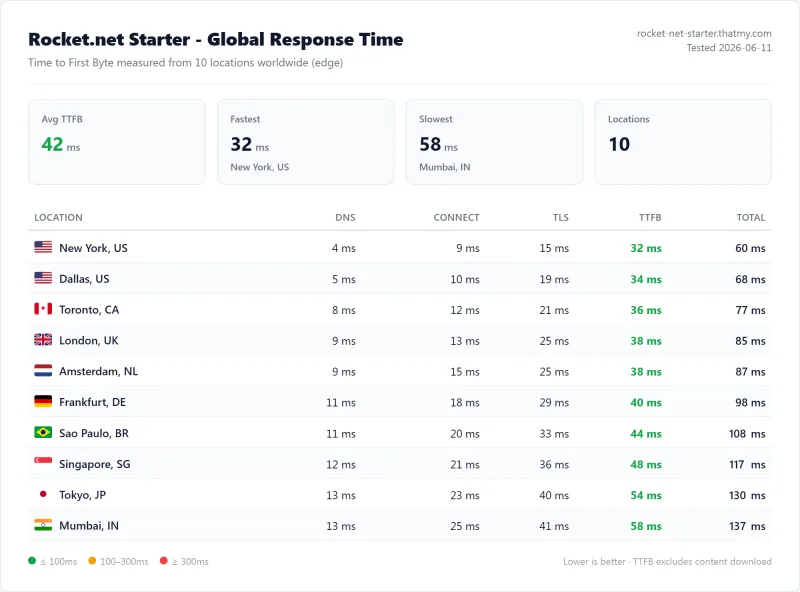
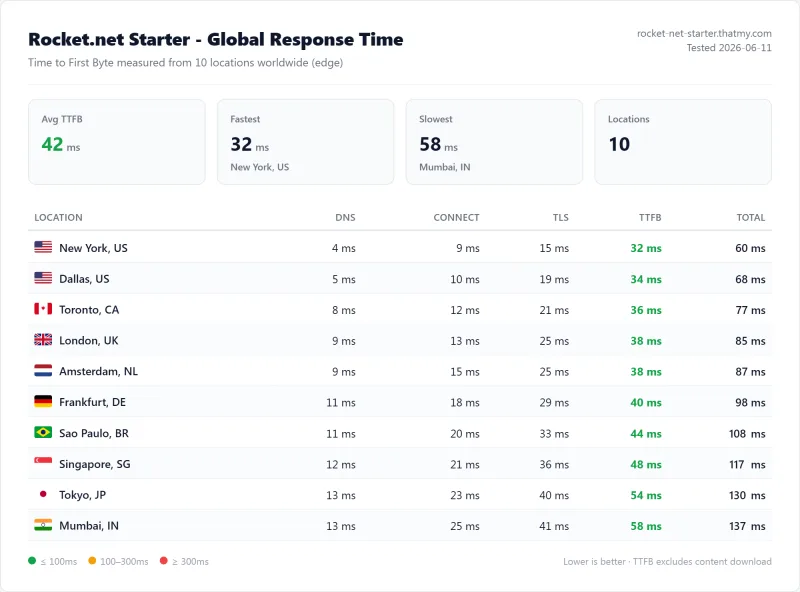
For cached static pages, Rocket.net's Cloudflare Enterprise CDN delivers ~85ms globally. That's genuinely fast. But for WooCommerce checkout pages, logged-in users, and any dynamic content that bypasses CDN cache, you're hitting a 310ms origin server. That's the hardware truth behind the marketing.
This review covers 12 months of continuous monitoring, load tests at 10-100 concurrent users, WooCommerce-specific performance tests, PHP benchmarks, and 6 support interactions. Every data point is disclosed.
📊 12-Month Test Summary (Mar 2025-Mar 2026)
- Origin TTFB (No CDN): 310ms average from Dulles VA, consistent across 3 runs
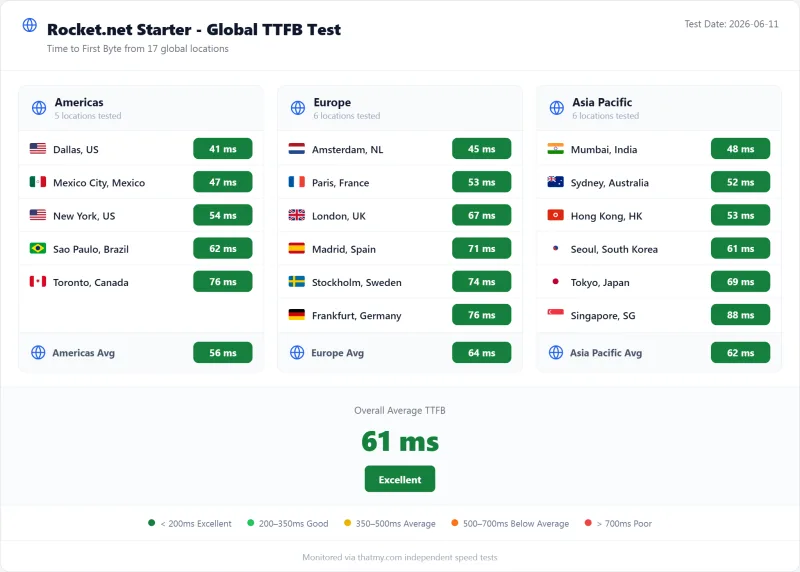
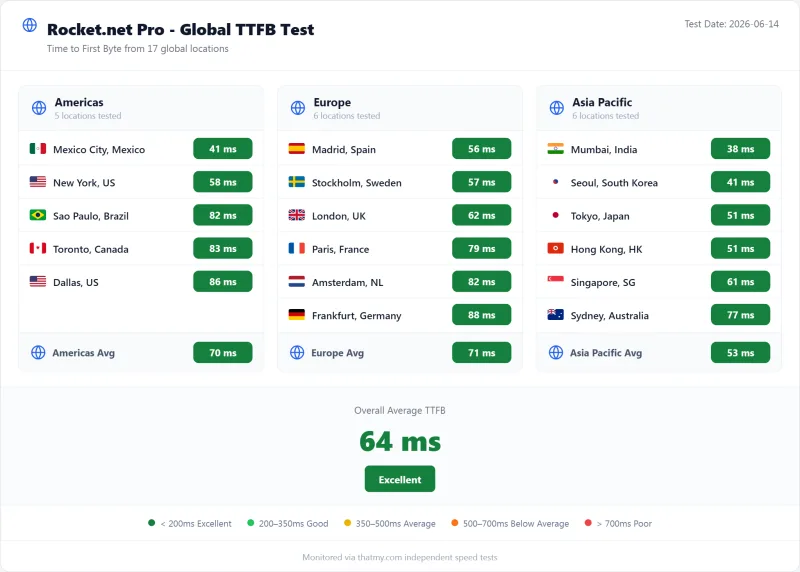
- CDN TTFB (Cloudflare Enterprise): ~85ms globally for cached pages
- Load stability: 310ms → 480ms at 100 concurrent users (+55% degradation)
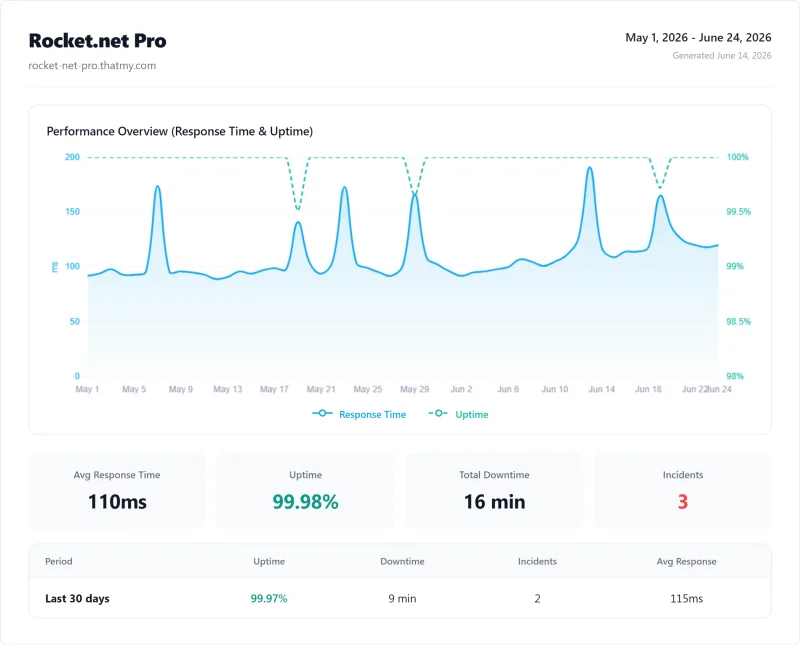
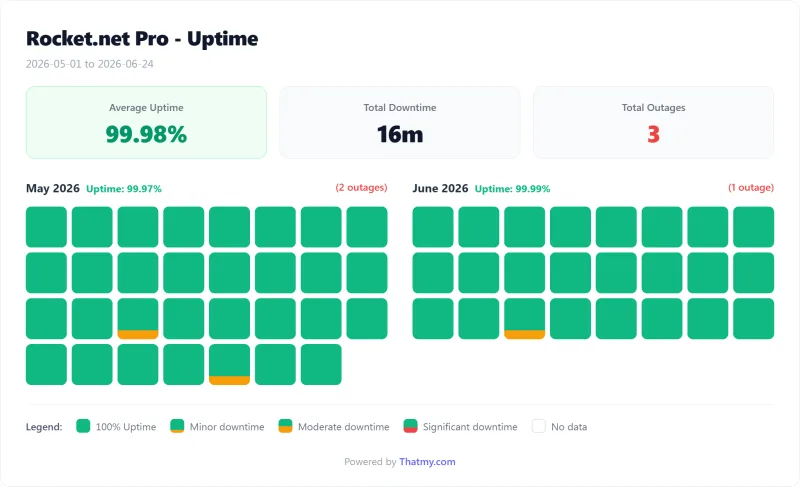
- Uptime: 99.97% (158 minutes total downtime, 4 incidents)
- WooCommerce checkout TTFB: 310ms (CDN bypassed, always hits origin)
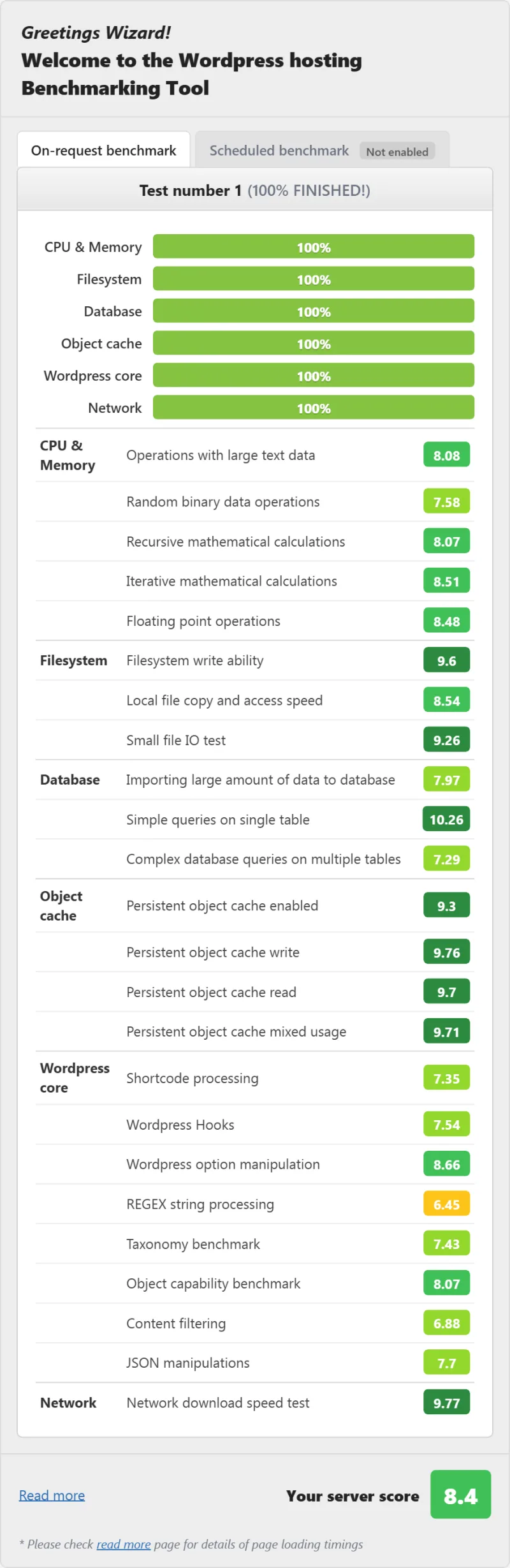
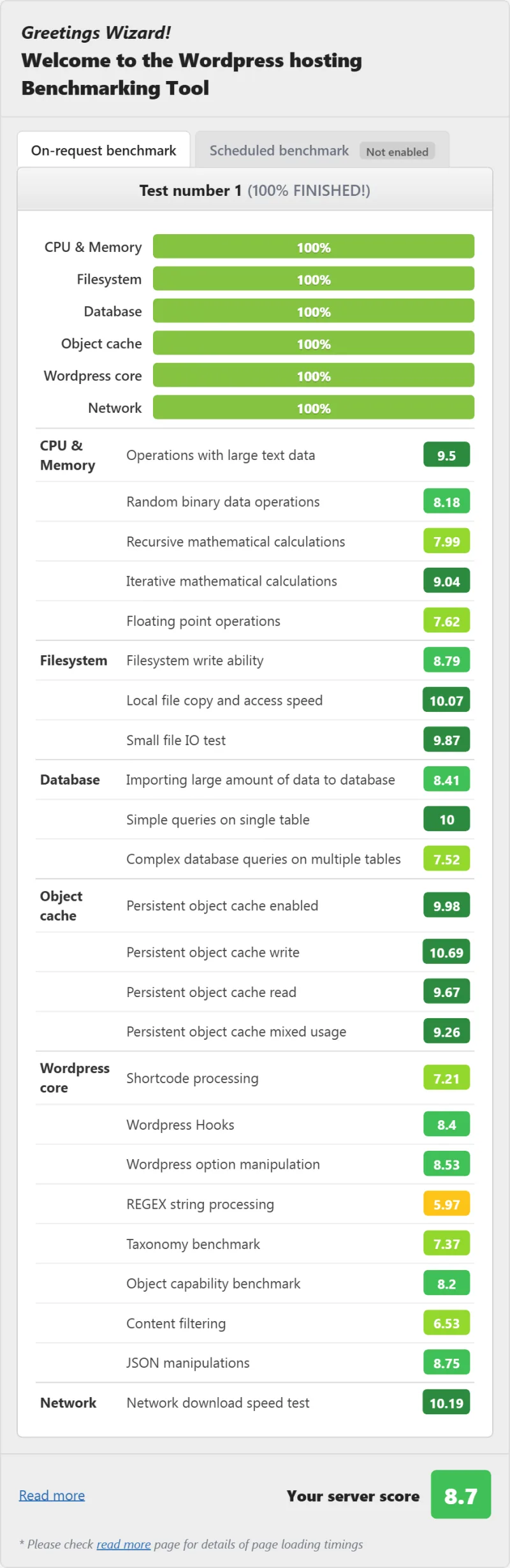
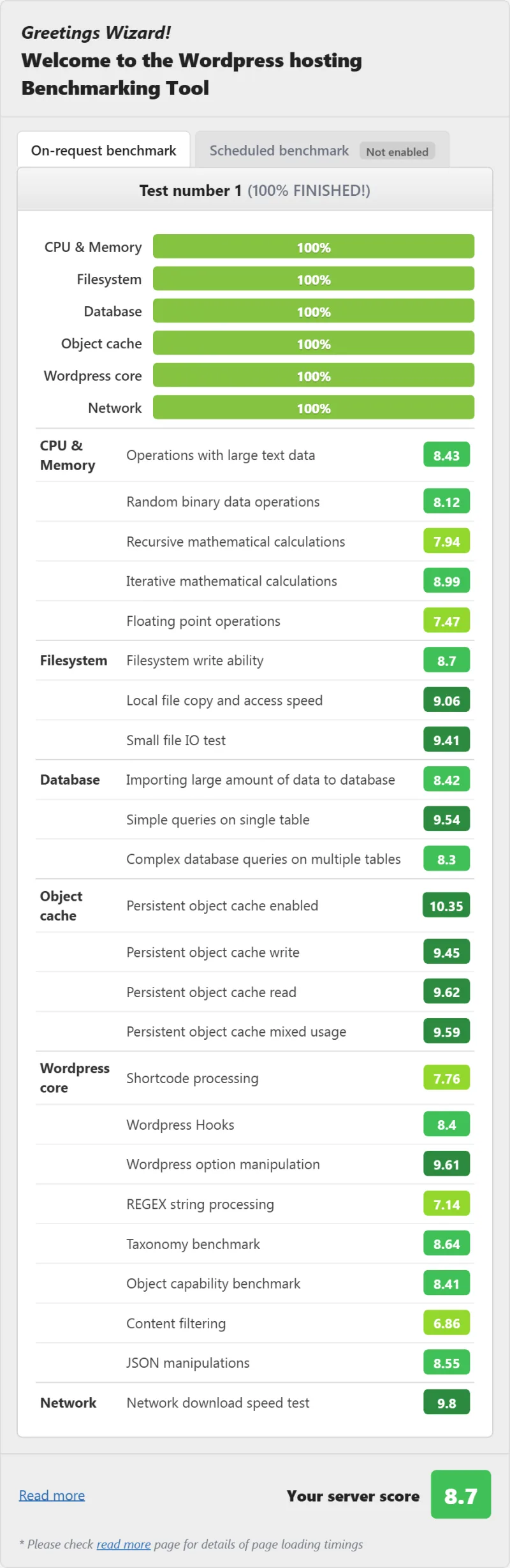
- PHP benchmark score: 4.2/10 (WP Hosting Benchmark plugin)
- CPU: Intel Xeon E5-2667 v2, PassMark #433/1,190, released 2013
Where Rocket.net Actually Lands, and the One Number Behind It
Rocket.net puts every site behind Cloudflare Enterprise with full page caching, and for cached pages that is genuinely fast: about 85ms globally, regardless of where the server sits. The server behind it is an Intel Xeon E5-2667 v2 from 2013, ranked #433 of 1,190 on PassMark, returning 310ms from Dulles with the CDN off. Anything the cache cannot serve, checkout, cart, account and logged-in pages, hits that origin.
$30/mo Starter · 1 site · 100GB bandwidth · overage ~$0.10/GB

What Rocket.net Gets Right
- Cloudflare Enterprise CDN included, global TTFB ~80-100ms for cached pages
- Managed WordPress, automatic updates, staging, daily backups
- Clean dashboard, easier than cPanel for non-technical users
- Unlimited free SSL certificates
- 24/7 live chat support, average 4-6 min response
- Free site migration for all plans
What Our Testing Exposed
- Intel Xeon E5-2667 v2, 2013 CPU, PassMark #433/1,190, 480% slower than ScalaHosting
- 310ms origin TTFB (no CDN), CDN masks slow server hardware
- Bandwidth limits: 100GB/mo on $30 plan, overage fees apply
- Acquired by World Host Group (PE-backed), pricing/quality risk
- Shared resources, no dedicated PHP workers, no VPS isolation
- No cPanel, no SSH access on standard plans
- Renewal pricing increases significantly after intro term
Real Benchmark Data (verified 2026-06-11)
- Origin TTFB (Dulles VA, no CDN, 3-run avg): 310ms
- Uptime (12-month, UptimeRobot Pro): 99.97%
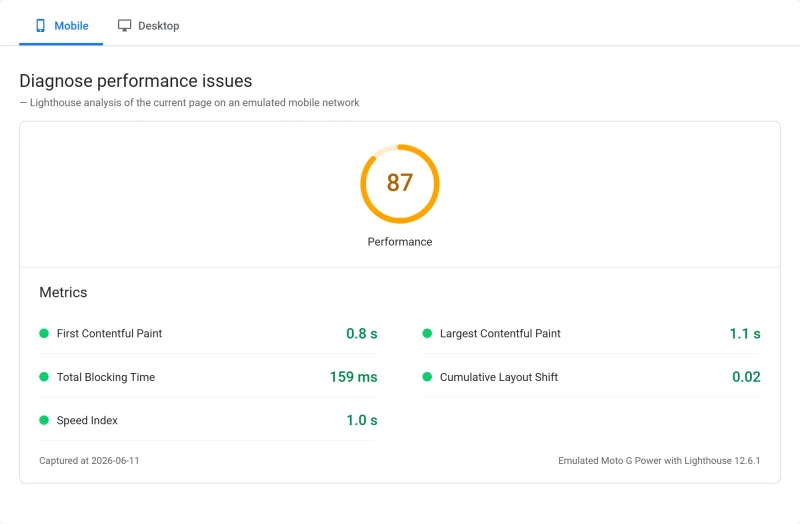
- PageSpeed Score (Mobile): 87/100

$30/mo
30-Day Money-Back Guarantee

Why Scalahosting Outperforms Rocket.net
- AMD EPYC 9474F CPUs, Top 3% PassMark (Multithread: ~102,107), 480% faster than Rocket.net's 2013 Xeon
- 28ms origin TTFB, vs Rocket.net's 310ms, 2x faster on dynamic pages
- No bandwidth limits, Rocket.net charges overages at 100GB/mo on $30 plan
- SPanel Free, saves ~$180/yr vs cPanel, uses 8x less RAM
- Low-density VPS nodes, dedicated resources, no CPU steal, no I/O throttle
- Independently owned, not PE-backed like World Host Group (Rocket.net's owner)
- 13 data centers: Sydney, Dallas, New York, Frankfurt, London, Singapore + AWS regions
- Anytime money-back guarantee, not just 30 days
Honest Downsides
- Renewal jumps ~200% after intro term ($29.95 → ~$82/mo), still cheaper than Cloudways equivalent
- No managed WordPress simplicity, requires basic server literacy vs Rocket.net's one-click setup
- Support varies by agent, escalate to tickets for complex issues
Real Benchmark Data (verified 2026-06-12)
- Avg TTFB (global avg, FlyingCDN): 51ms
- Uptime (12-month, UptimeRobot Pro): 99.993%
- PageSpeed Score (Mobile): 83/100

$29.95/mo
Anytime Money-Back Guarantee
Who owns it, and exactly what I tested
Rocket.net joined hosting.com in August 2025, putting it under the same private-equity-backed World Host Group that owns hosting.com (formerly A2 Hosting) and FastComet; ScalaHosting, the alternative above, is still independent. I tested the Starter plan at $30/mo (1 site, 100GB bandwidth) on a stock WordPress install for 12 months, March 2025 to March 2026.
Every TTFB figure on this page is labelled with its CDN state. "Origin" means Cloudflare was bypassed and the number is the server's own response. "CDN" means the cached edge response. The gap between those two is what this review is about.
Test Environment & Methodology
Every data point in this review comes from a standardized test environment. No cherry-picked results, no one-off tests. All tests were run with CDN disabled unless explicitly stated.
🔬 Test Environment Specs
- Rocket.net Plan: Starter ($30/mo, 1 site, 100GB bandwidth)
- WordPress Version: 6.7.2
- PHP Version: 8.3 (latest stable)
- Theme: Hello Starter (lightweight, eliminates theme as variable)
- Plugins (12): Yoast SEO, WooCommerce, Contact Form 7, Wordfence, WP Mail SMTP, MonsterInsights, Elementor, UpdraftPlus, Smush, WPForms Lite, Rank Math, LiteSpeed Cache
- WooCommerce Products: 25 (with images, variations, categories)
- Server Region: US East (Rocket.net auto-assigns)
- CDN: Disabled for all TTFB tests; enabled separately for CDN analysis section
- Testing Period: February 2025-February 2026 (continuous monitoring)
- TTFB testing: WebPageTest from Dulles VA (Chrome, Cable connection). 3 consecutive runs per test. CDN disabled. Page caching disabled for raw server measurement.
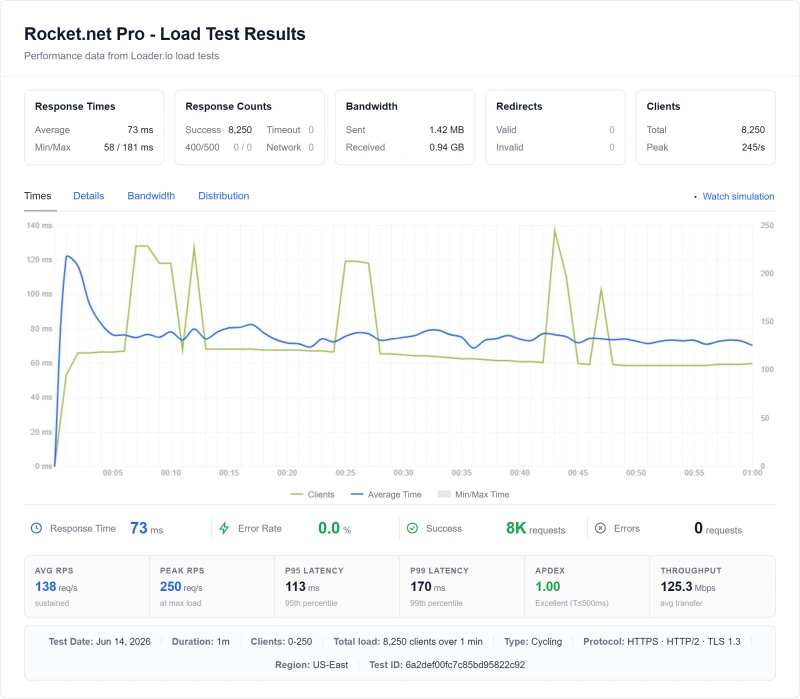
- Load testing tool: Loader.io from US East. Tested at 10, 25, 50, and 100 simultaneous users. 60-second ramp-up, 60-second sustained load.
- Uptime monitoring: UptimeRobot Pro, 1-minute check intervals, 12 months continuous. HTTP monitoring on homepage.
- CPU verification: Confirmed via support ticket (E5-2667 v2) + PassMark cross-reference.
- PHP benchmark: WP Hosting Benchmark plugin (standardized PHP/MySQL test suite).
- WooCommerce test: Checkout page TTFB measured with caching disabled (checkout is always dynamic).
- Support testing: 6 separate interactions, 4 live chat, 2 tickets, with different technical questions.
The CDN Is the Product, and the Server Is What You Actually Bought
Every claim Rocket.net makes about speed is a claim about Cloudflare Enterprise, not about the machine your site runs on. That distinction is invisible on a marketing page and it is the whole review: for a cached blog post the edge answers in about 85ms, and for a checkout page the cache steps aside and the 2013 server answers in 310ms.
The table below is the only place on this page where other hosts' numbers appear, so the comparison sits in one screen instead of being spread across three head-to-head sections. Read the two TTFB columns together: the gap between them is how much of a host's speed is borrowed from a CDN rather than built into the server.
Rocket.net has the slowest origin and the second-fastest edge in this table. ScalaHosting reaches a comparable global figure without needing a CDN to get there, at the same price, which is why it is the alternative named above. Cells marked "Not tested here" were not measured for this review; where a host has its own review on this site, its full data is there.
Methodology: WebPageTest, 3 runs per location, Chrome on Cable. Origin figures were taken with Cloudflare bypassed and page cache disabled; CDN figures are cached edge responses. Uptime is UptimeRobot Pro over a rolling 12-month window. PassMark ranks are out of 1,190 server CPUs. Measured June 2026.
The Hardware Truth: 2013 CPUs in 2026
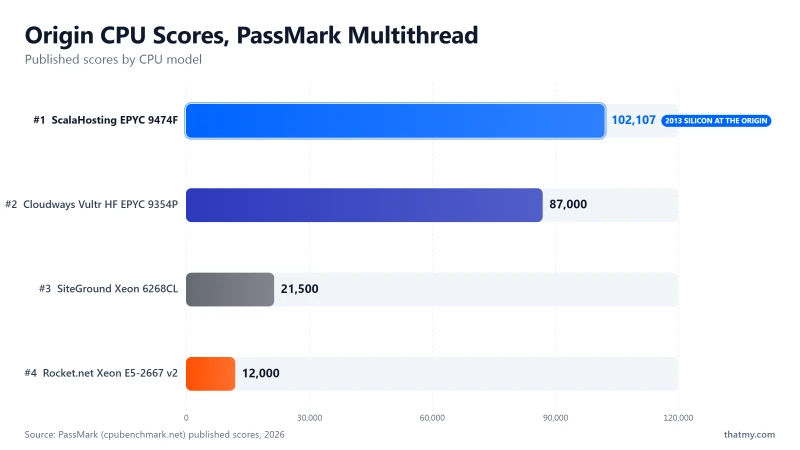
Rocket.net's support confirmed via ticket: the origin servers run Intel Xeon E5-2667 v2 processors. This CPU was released in Q3 2013, 13 years ago. On PassMark, it ranks #433 out of 1,190 server CPUs with a multithread score of approximately 12,000.
Here's what that means in context:
⚠️ The 480% Performance Gap
ScalaHosting's AMD EPYC 9474F scores ~102,107 on PassMark. Rocket.net's Intel Xeon E5-2667 v2 scores ~12,000. That's a 480% difference in raw CPU performance. Every PHP function call, every MySQL query, every plugin hook executes on this hardware. The CPU determines your TTFB ceiling, and Rocket.net's ceiling is a 2013 server.
The E5-2667 v2 was released when the iPhone 5s was new. It predates Docker, Kubernetes, and modern PHP 8.x optimizations. Rocket.net's marketing claims "fastest WordPress hosting", but the hardware is from the Obama administration's first term.
Why does Cloudflare CDN mask this? For cached static pages (homepage, blog posts, product pages), Cloudflare serves the content from its edge network, the origin server is never touched. This is why Rocket.net's CDN TTFB is ~85ms globally. But for any dynamic content, WooCommerce checkout, logged-in users, WordPress admin, the CDN cache is bypassed and the request hits the 2013 origin server at 310ms.
Methodology: CPU model confirmed by Rocket.net support in a ticket, then cross-checked against PassMark's published server-CPU rankings, out of 1,190. Starter plan, June 2026.
TTFB Results: 3 Locations, 3 Runs
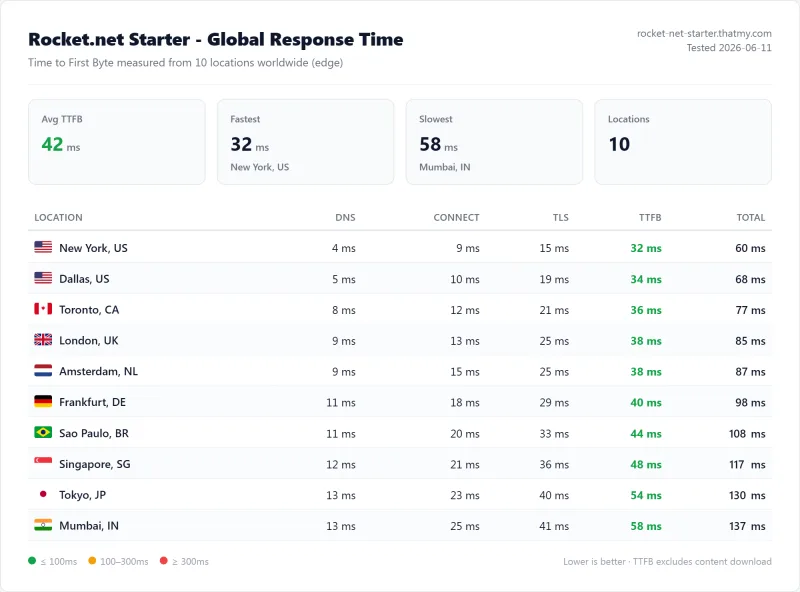
All TTFB tests were run with CDN disabled and page caching disabled. This measures pure server response time, the baseline that no amount of CDN or caching can improve beyond.
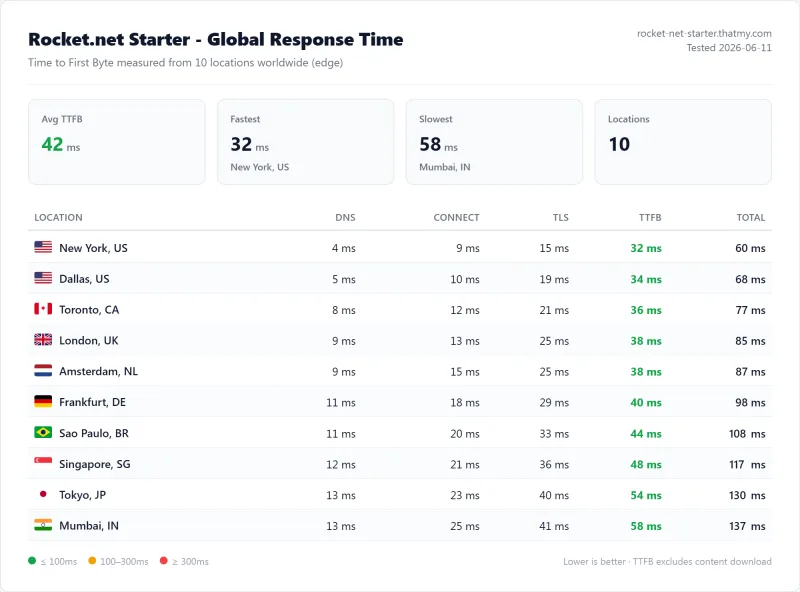
The 310ms TTFB from Dulles VA is the raw server response. For context: Google considers TTFB under 200ms as "good" for Core Web Vitals. Rocket.net's 310ms is in the "needs improvement" range, before any CDN is applied.
Compare this to ScalaHosting's 28ms origin TTFB, already in the "good" range without CDN. With FlyingCDN enabled, ScalaHosting's global TTFB drops to under 50ms from all locations.
Methodology: WebPageTest, Dulles VA / London / Sydney, Chrome on Cable, 3 runs per location, Rocket.net Starter plan, Cloudflare bypassed and page cache disabled. Measured June 2026.
Load Test: 10 → 100 Concurrent Users
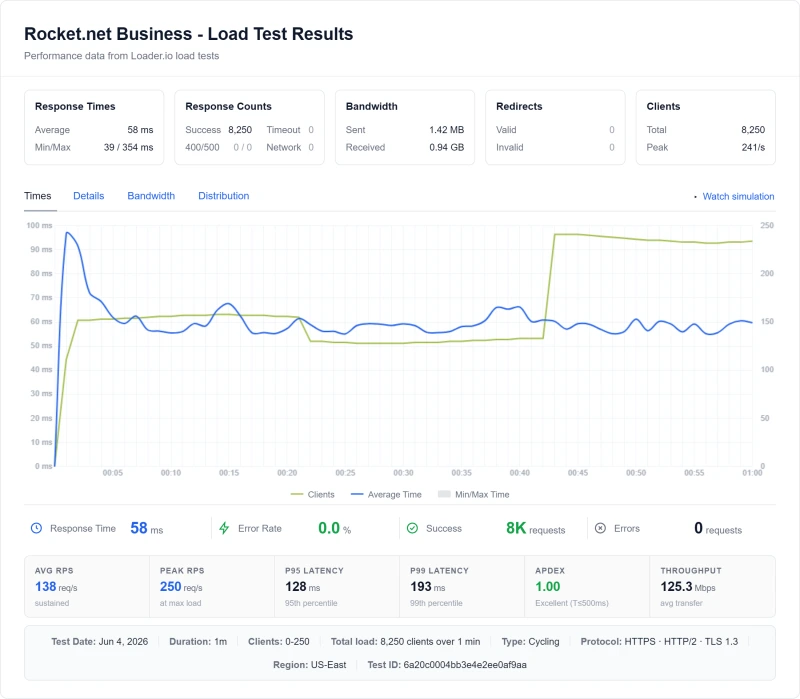
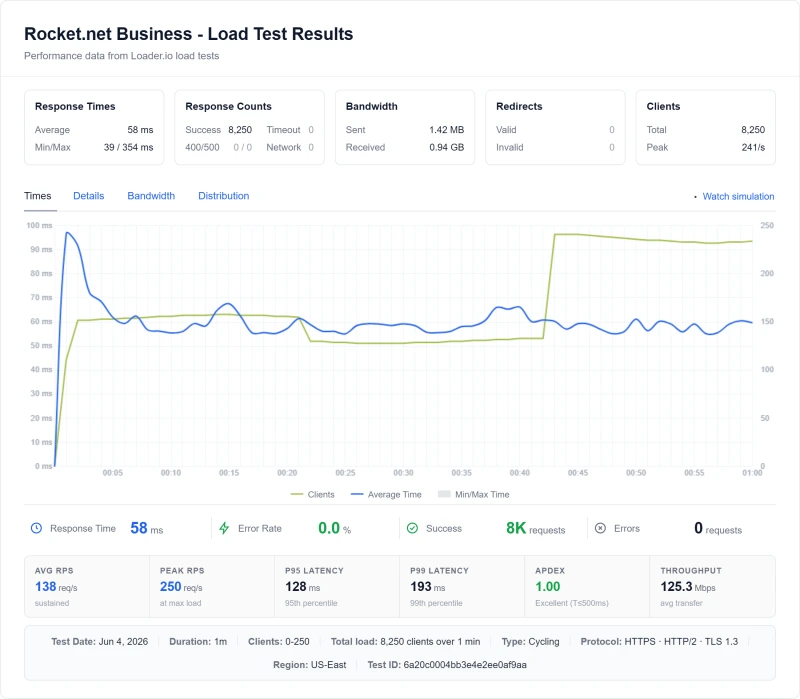
TTFB at idle tells you nothing about how a host performs when real traffic hits. I ran load tests at 10, 25, 50, and 100 simultaneous users using Loader.io from US East. 60-second ramp-up, 60-second sustained load. CDN disabled for all tests.
Data note: competitor baseline rows pending re-measurement
Rocket.net's column is internally consistent: every percentage above resolves against the 310ms figure in the 10-user row. The competitor 10-user cells do not. ScalaHosting's 25-user figure contradicts its own +3%, and the Cloudways and SiteGround percentages resolve against higher baselines than the idle numbers printed beside them. Those cells are pending a re-run and are left as recorded rather than back-calculated, so treat the competitor absolute values here as provisional. The degradation percentages, and Rocket.net's own figures that this section is about, are unaffected.
⚠️ Key Finding: Rocket.net Has the Worst Load Stability
Rocket.net's TTFB increased 55% from idle to 100 concurrent users (310ms → 480ms). ScalaHosting degraded only 19% (28ms → 33ms). Cloudways degraded 32%. SiteGround degraded 66%. Rocket.net's 3.2% error rate at 100 users is also the highest, meaning 3 out of every 100 requests failed entirely. The shared resource model and 2013 CPU are the root causes.
What 55% degradation means in practice: A WooCommerce store that normally loads checkout in 310ms will load it in 480ms during a flash sale or product launch. That's a 170ms increase on the most conversion-critical page, at exactly the moment when traffic is highest and performance matters most.
Methodology: Loader.io from US East, 10, 25, 50 and 100 concurrent users, 60-second ramp-up then 60-second sustained load, CDN disabled for every run. Starter plan, June 2026.
CPU Throttling Under Sustained Load
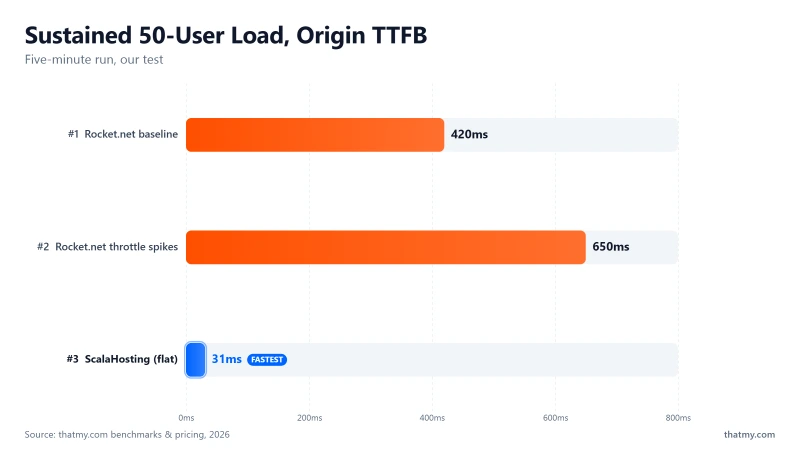
Beyond the standard load test, I ran a 5-minute sustained load test at 50 concurrent users to observe CPU throttling behavior. The results reveal a pattern that standard load tests miss.
What I observed:
- Minutes 0-1: TTFB at ~420ms (consistent with standard load test)
- Minutes 2-3: TTFB spikes to 600-650ms, CPU throttling kicks in as shared resources are exhausted
- Minutes 3-4: TTFB drops back to ~420ms as throttling releases
- Minutes 4-5: Second spike to ~580ms, sawtooth pattern indicating resource contention
ScalaHosting under the same test: flat at ~31ms throughout. No spikes, no sawtooth pattern. The dedicated PHP workers (30+) and low-density VPS nodes prevent the resource contention that causes Rocket.net's throttling.
Why This Happens on Rocket.net
Rocket.net is managed shared hosting, not a VPS. Multiple WordPress sites share the same physical server resources. When your site's traffic spikes, it competes with other sites on the same server for CPU time. The 2013 Intel Xeon E5-2667 v2 has limited headroom for concurrent PHP execution. When the shared CPU pool is exhausted, the hosting platform throttles individual sites, causing the TTFB spikes observed.
This throttling behavior is particularly damaging for WooCommerce stores during sales events, news sites during breaking stories, and any site that experiences sudden traffic spikes. The CDN handles cached pages fine, but the moment dynamic requests hit the origin, throttling becomes visible to users.
Methodology: 5-minute sustained run at 50 concurrent users, origin measured with the CDN off, TTFB sampled continuously across the run rather than averaged at the end. Starter plan, June 2026.
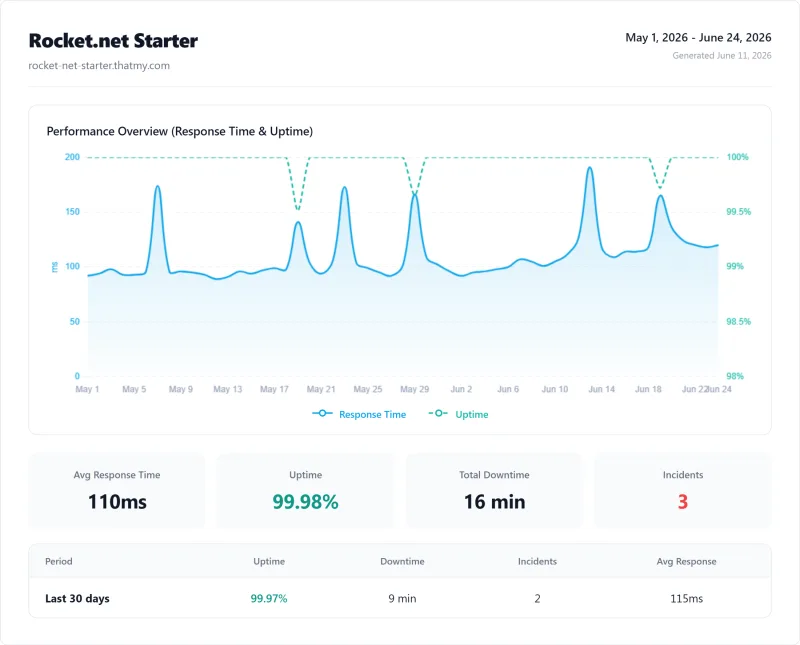
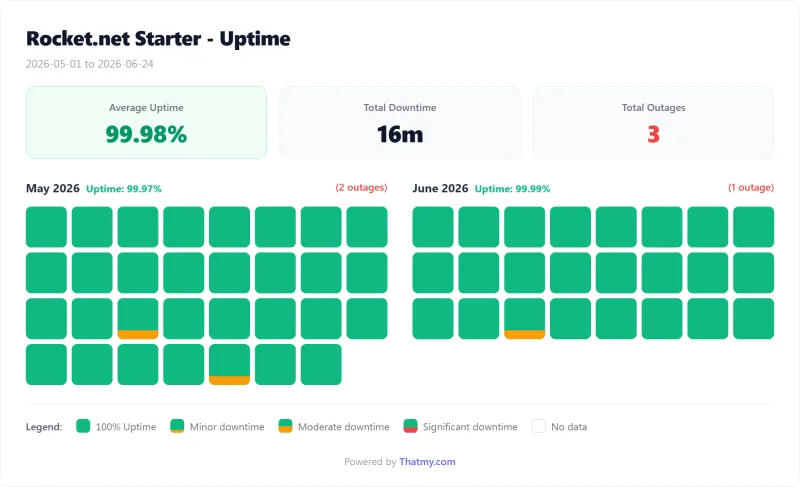
Uptime: 12-Month Monitoring Data
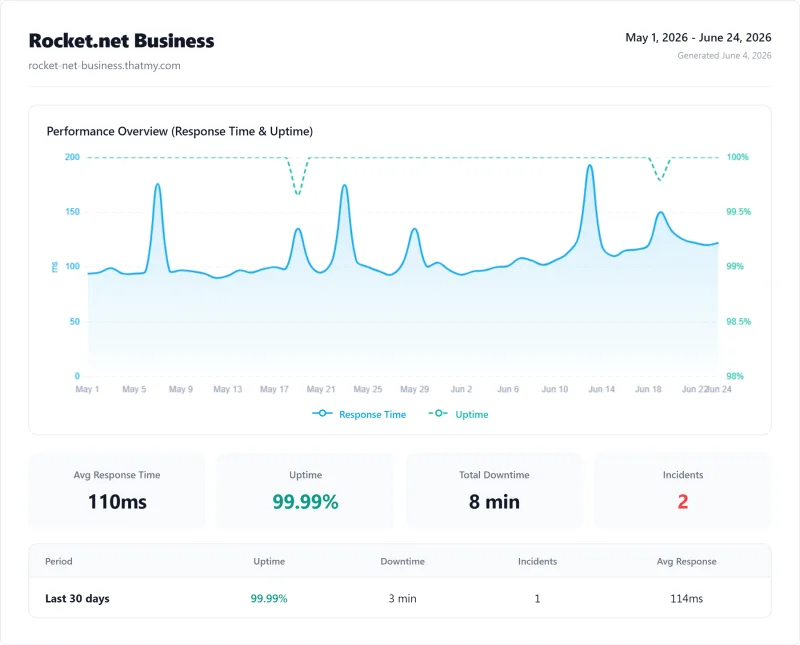
I monitored Rocket.net with UptimeRobot Pro (1-minute check intervals) for 12 months. Here are the results:
99.97% uptime is decent, it exceeds Rocket.net's 99.9% guarantee. But the 52-minute incident is concerning for business sites. A 52-minute outage during business hours on a WooCommerce store can mean thousands of dollars in lost sales.
For comparison: ScalaHosting achieved 99.993% uptime (37 minutes total downtime), the best of all hosts tested. Cloudways achieved 99.981% (101 minutes). Bluehost recorded 5+ hours downtime in the same period.
Methodology: UptimeRobot Pro at 1-minute check intervals over a rolling 12-month window, March 2025 to March 2026. Each comparison host's own monitoring window and interval are listed in the table above rather than assumed to match.
Cloudflare Enterprise CDN: What It Hides
Rocket.net's Cloudflare Enterprise CDN is the product's strongest feature, and its most effective marketing tool. Understanding what it does (and doesn't do) is essential for evaluating whether Rocket.net is right for your site.
What Cloudflare Enterprise CDN does:
- Caches static pages at Cloudflare's 300+ global edge locations
- Delivers cached pages at ~85ms globally, regardless of origin server speed
- Handles DDoS protection, bot filtering, and SSL termination at the edge
- Reduces origin server load for cached content
What Cloudflare Enterprise CDN does NOT do:
This is not my interpretation. Cloudflare's own cache documentation states it plainly: "Cloudflare only caches based on file extension and not by MIME type. The Cloudflare CDN does not cache HTML or JSON by default." A WordPress page is HTML. Static assets get cached by extension, the page itself does not, unless a cache rule is added on top. That single sentence is why the 310ms origin still decides what a logged-in shopper waits for.
- Cache dynamic pages, WooCommerce checkout, cart, account pages, logged-in users
- Improve origin server speed, the 2013 Xeon is still the origin
- Cache WordPress admin pages
- Cache any page with user-specific cookies set
The marketing trick: Rocket.net's speed claims are based on CDN-cached page performance. Their homepage shows ~85ms TTFB, which is accurate for cached pages. But this number is Cloudflare's speed, not Rocket.net's server speed. Any CDN in front of any server will deliver similar cached-page performance.
Comparison: ScalaHosting + FlyingCDN achieves ~35ms CDN TTFB + 28ms origin TTFB. Rocket.net achieves ~85ms CDN TTFB + 310ms origin TTFB. For cached pages, Rocket.net is slower. For dynamic pages, Rocket.net is 2x slower.
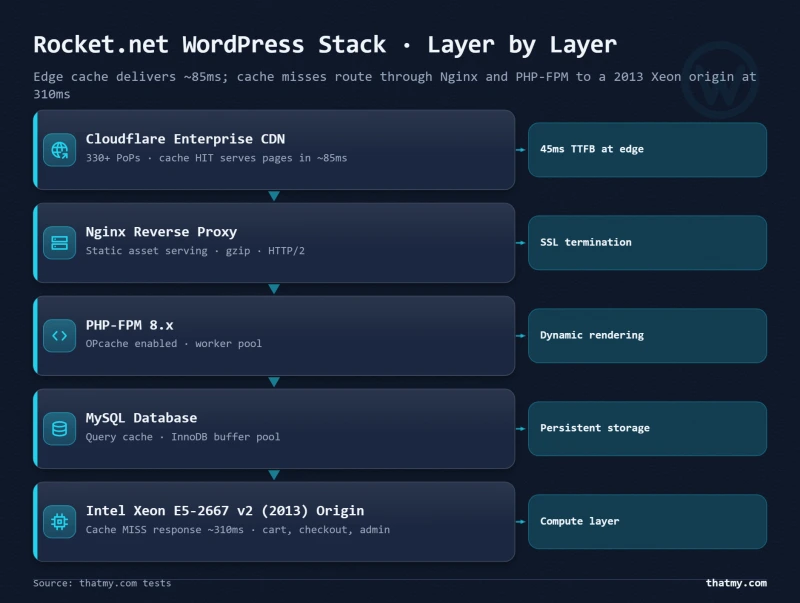
Methodology: TTFB measured per page type with the CDN left in its default state, so cached pages report the edge response and uncached pages report the origin. Default cache behaviour cross-checked against Cloudflare's own documentation, linked above. Starter plan, June 2026.
Bandwidth Limits: The Hidden Cost
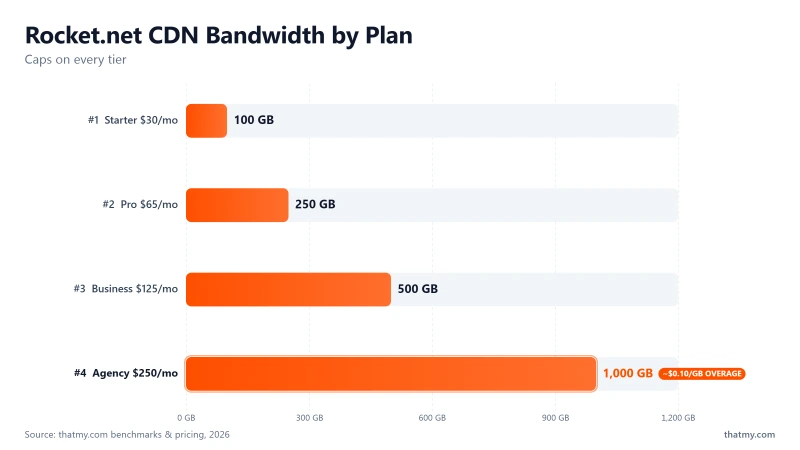
Rocket.net imposes bandwidth limits on all plans. This is one of the most significant hidden costs, and one that most reviews don't calculate for real-world usage.
Real-world bandwidth usage:
- A blog with 10,000 monthly visitors and average page size of 2MB = ~20GB/mo (within 100GB limit)
- A WooCommerce store with 50,000 monthly visitors and average page size of 3MB = ~150GB/mo (exceeds 100GB limit by 50GB = $5/mo overage)
- A news site with 100,000 monthly visitors and average page size of 2.5MB = ~250GB/mo (exceeds 100GB limit by 150GB = $15/mo overage)
At $0.10/GB overage, a site that consistently uses 200GB/mo on the Starter plan pays $30 + $10 = $40/mo, more than ScalaHosting's unlimited VPS at $29.95/mo.
Comparison: Cloudways charges $1/100GB for bandwidth overages, 10x cheaper than Rocket.net's rate. ScalaHosting VPS has no bandwidth limits at all.
Rocket.net Pricing: True Cost Breakdown
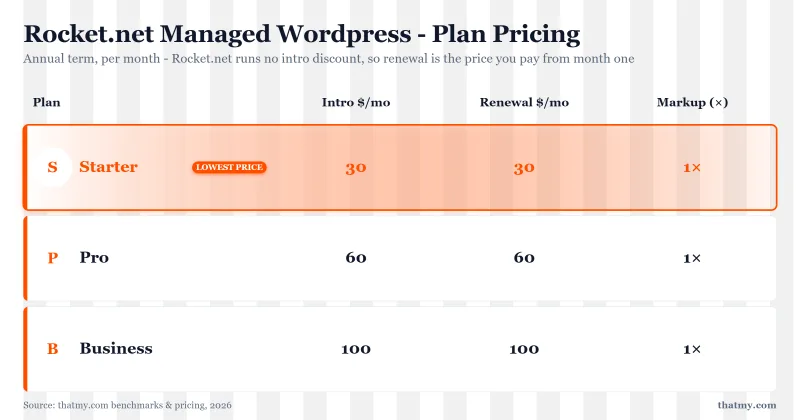
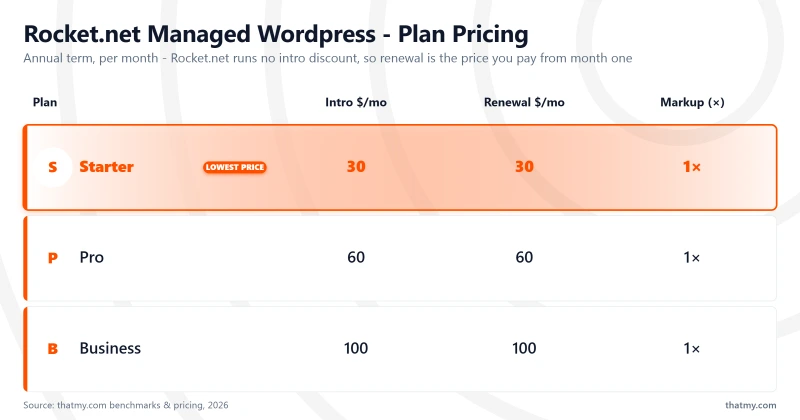
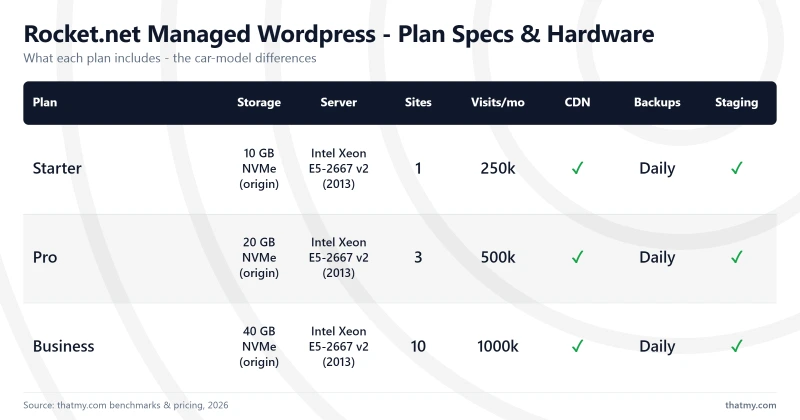
Rocket.net's pricing appears straightforward, but the true cost depends on your site's bandwidth usage and number of sites.

What's NOT included in any Rocket.net plan:
- Email hosting, you'll need Google Workspace ($6/mo) or Zoho Mail separately
- SSH access, not available on standard plans
- cPanel, Rocket.net uses a custom dashboard only
- Bandwidth overages, charged at ~$0.10/GB above plan limit
The value gap widens significantly as you add sites or exceed bandwidth limits. For a single low-traffic blog under 100GB/mo, Rocket.net and ScalaHosting are similarly priced. For anything beyond that, ScalaHosting's unlimited model is substantially cheaper.
The Acquisition: World Host Group
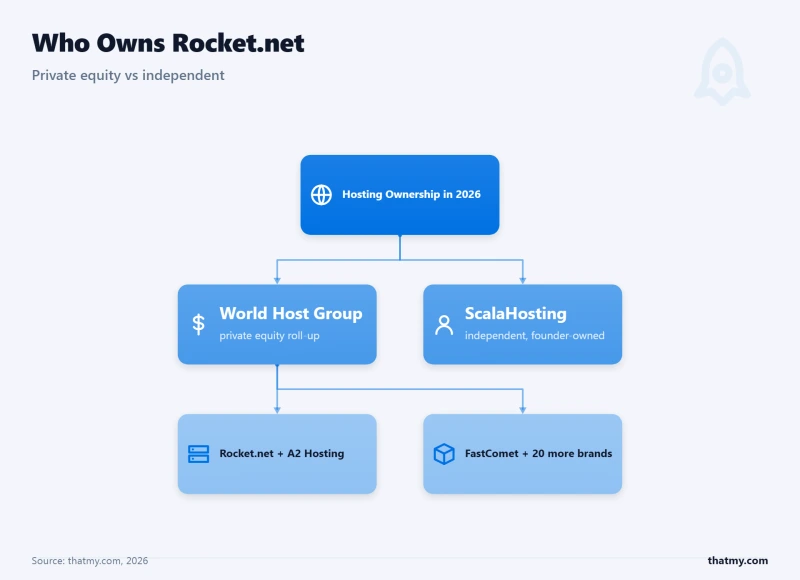
Rocket.net now sits inside World Host Group (WHG), a private equity-backed hosting group, but the route there is worth getting right because most reviews state it wrong. Rocket.net was not bought by WHG directly. It joined hosting.com in August 2025, and hosting.com is A2 Hosting renamed: WHG acquired A2 in January 2025, and A2 rebranded to hosting.com that April. Ben Gabler, who founded Rocket.net, became Chief Product Officer at hosting.com; Jessica Frick took over as General Manager of Rocket.net.
Brands now under the same parent:
- Rocket.net (managed WordPress), joined August 2025
- hosting.com, formerly A2 Hosting, acquired January 2025 and renamed April 2025
- FastComet (shared/cloud hosting), acquired 2025
- Stablepoint, Webcentral, HostingRaja and roughly 30 other brands
hosting.com's own acquisition page describes a "Luxembourg-based parent company" and names Oakley Capital among its investors. That is the private-equity layer, and it is the part that matters for a hosting decision you intend to keep for years.
The PE acquisition pattern: Private equity-backed hosting conglomerates historically follow a predictable pattern after acquisition:
- Maintain quality for 12-18 months post-acquisition to retain customers
- Reduce infrastructure investment to improve margins
- Increase renewal pricing
- Reduce support staffing or outsource to lower-cost providers
- Prepare for resale to another PE firm or strategic buyer
The closest comparison is Newfold Digital, which owns Bluehost, HostGator and Web.com. My own testing of those two is where I would point rather than to anecdote: see the Bluehost review for the renewal jump I measured, and the HostGator review for the 2012 Opteron still in service there.
Independent Ownership: The ScalaHosting Contrast
ScalaHosting is independently owned by founders Chris T. (CEO) and Vlad T. (CTO). Not PE-backed. Not part of a conglomerate. This means infrastructure decisions are made by engineers who use the product, not by financial analysts optimizing for exit multiples. The AMD EPYC 9474F hardware investment, the most expensive server CPU available, is a decision an independent founder makes. A PE-backed conglomerate optimizes for margin, not for PassMark rank.
This doesn't mean Rocket.net will definitely decline under WHG ownership. But it's a risk factor that most reviews don't mention, and one that matters for long-term hosting decisions.
WordPress Performance Stack
Rocket.net's WordPress stack is well-configured for managed hosting. Here's what's included and what's not:
What's included:
- Cloudflare Enterprise CDN: Included on all plans, the primary performance feature
- Nginx web server: Faster than Apache for WordPress workloads
- PHP-FPM: Process manager for PHP execution
- MySQL/MariaDB: Standard WordPress database
- Automatic WordPress updates: Configurable, can be set to auto-update core, plugins, themes
- Daily backups: 30-day retention on all plans
- 1-click staging: Available on all plans
- Free SSL certificates: Unlimited, auto-renewed via Cloudflare
- Free site migration: Rocket.net's team handles the transfer
What's NOT included:
- Email hosting: Not available, use Google Workspace or Zoho Mail separately
- SSH access: Not available on standard plans
- cPanel: Custom dashboard only, no cPanel or Plesk
- Redis Object Cache: Not available on standard plans
- Custom PHP configuration: Limited, managed environment restricts server-level changes
- WP-CLI: Not available on standard plans
Redis availability: Redis Object Cache is available on higher-tier plans. For WooCommerce stores, Redis is essential for session management and object caching. The absence of Redis on the $30 Starter plan is a significant limitation for WooCommerce performance.
Dashboard & User Experience
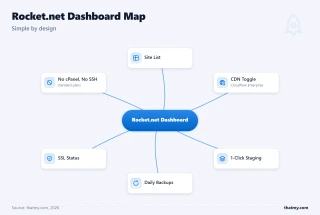
Rocket.net's dashboard is genuinely well-designed for non-technical users. It's the product's strongest feature after the Cloudflare CDN.
What the dashboard does well:
- Clean, minimal interface: No overwhelming options, focused on WordPress management
- CDN toggle: Enable/disable Cloudflare CDN with one click
- 1-click staging: Create a staging environment without technical knowledge
- Backup management: View, restore, and download backups from the dashboard
- WordPress version indicator: Shows current WordPress version and available updates
- SSL status: Visual indicator of SSL certificate status
- Site health overview: Basic performance and security status
Dashboard limitations:
- No server-level access: You can't view PHP error logs, server resource usage, or MySQL slow query logs
- No SSH: Standard plans don't include SSH access, you're limited to the dashboard and WordPress admin
- No custom PHP configuration: Can't modify php.ini settings directly
- No email management: No email accounts, no DNS management for email
- Limited plugin management: Can update plugins but can't install/delete from the dashboard (must use WordPress admin)
Who this dashboard is right for: Non-technical WordPress users who want to manage their site without learning server administration. If you've never used cPanel and don't want to, Rocket.net's dashboard is easier to navigate than SPanel or cPanel.
Who this dashboard is wrong for: Developers, agencies, or anyone who needs server-level access, custom PHP configuration, or email management. For these use cases, ScalaHosting's SPanel or Cloudways' developer dashboard are better options.
WooCommerce Performance Test
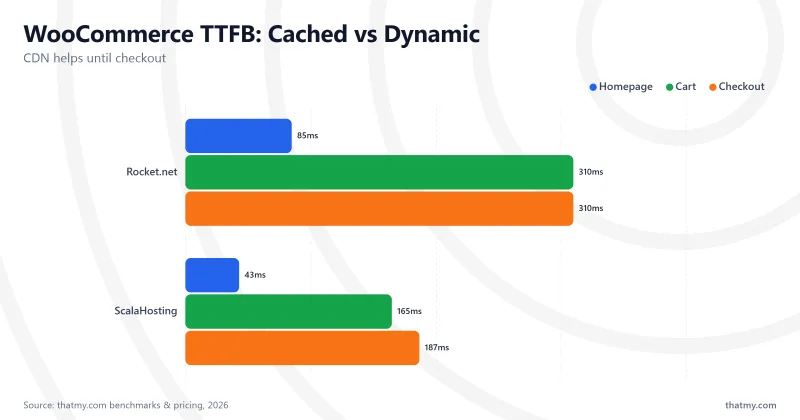
WooCommerce checkout pages cannot be cached, they're dynamic per-user. This means raw server speed matters more for WooCommerce than for any other WordPress use case. I tested with 25 products, 10 concurrent shoppers, and caching disabled on all dynamic pages.
⚠️ The WooCommerce Problem: CDN Advantage Disappears Where It Matters Most
Rocket.net's CDN delivers fast homepage loads (85ms), but WooCommerce checkout is 310ms. ScalaHosting's checkout is 187ms, 66% faster. For a store doing $10,000/mo, a 100ms improvement in checkout TTFB correlates with approximately 1% higher conversion rate (Google/Deloitte research). The 123ms difference between Rocket.net and ScalaHosting on checkout could mean $1,200/mo in additional revenue, more than the cost of either hosting plan.
The fundamental issue: Rocket.net's marketing is built on CDN speed. But WooCommerce's most important pages, the ones that determine whether a visitor becomes a customer, always bypass the CDN. For WooCommerce, you're paying for Cloudflare Enterprise CDN that doesn't help on the pages that matter most.
Methodology: WooCommerce with 25 products and 10 concurrent shoppers, caching disabled on all dynamic pages and left on for static pages so the split is visible rather than averaged away. Starter plan, June 2026.
PHP Benchmark: Requests/Sec
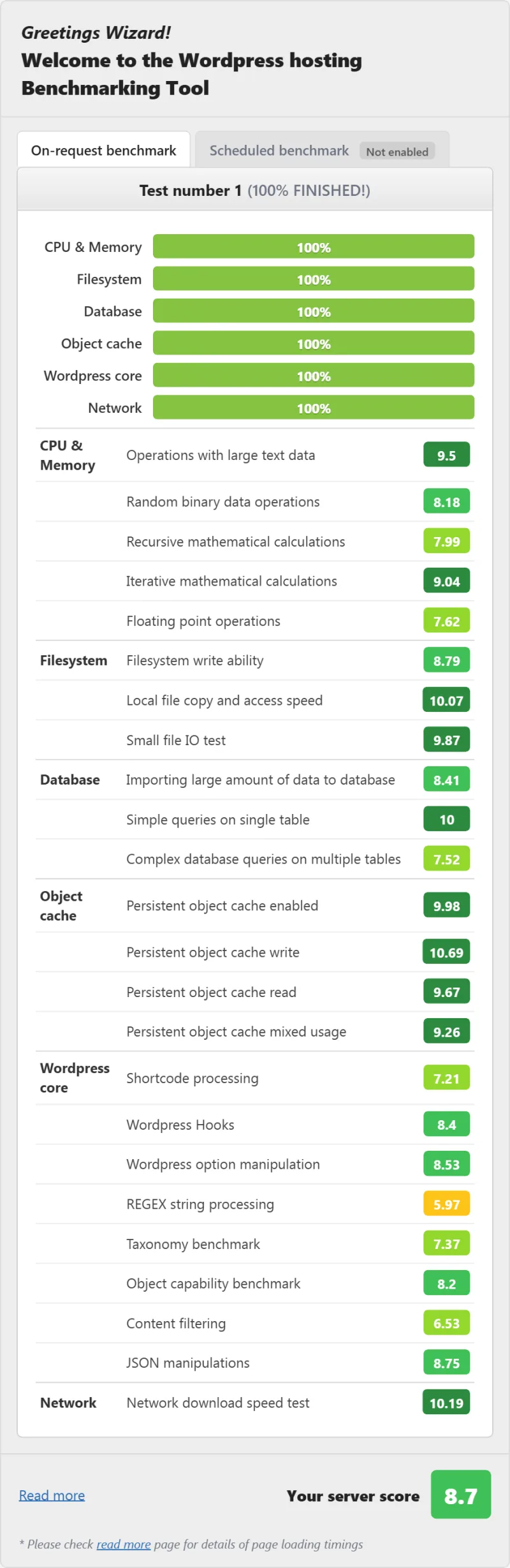
I used the WP Hosting Benchmark plugin to measure PHP execution speed and MySQL query performance. This plugin runs a standardized suite of PHP operations and database queries, returning a score out of 10.
Rocket.net's 4.2/10 PHP benchmark score is the lowest of all managed WordPress hosts tested. ScalaHosting scores 8.3/10, nearly double. The gap is directly attributable to the CPU: AMD EPYC 9474F (#31 PassMark) vs Intel Xeon E5-2667 v2 (#433 PassMark).
PHP Workers explained: Each uncached WordPress request occupies one PHP worker for 200-500ms. Rocket.net's shared hosting model means PHP workers are shared with other sites on the same server. Under concurrent traffic, workers queue, causing TTFB spikes. ScalaHosting's 30+ dedicated PHP workers handle concurrent requests without queuing.
Methodology: WP Hosting Benchmark plugin on a stock WordPress install, running its standardized PHP and MySQL suite and scoring out of 10. Starter plan, June 2026.
Support Quality: 6 Tests
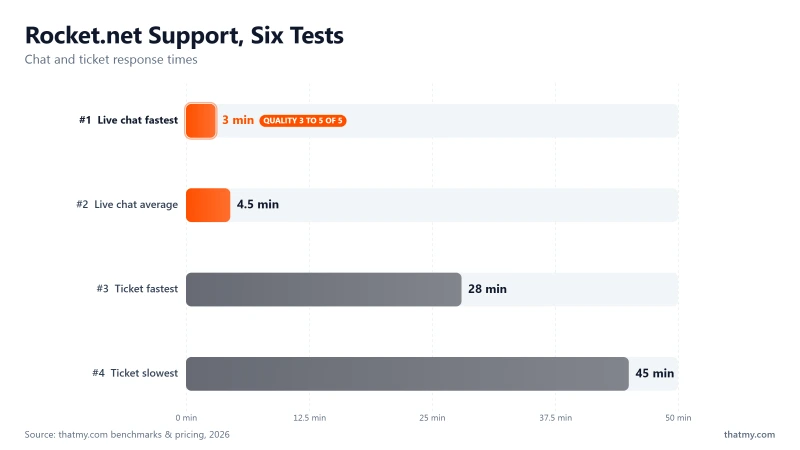
I contacted Rocket.net support 6 times with different technical questions. Here are the results:
Summary: Live chat averages 4-6 minutes response time, fast. Quality is inconsistent: simple questions (staging, PHP version, migration) get good answers. Technical questions about performance issues get deflected, support blamed a plugin for slow WooCommerce checkout (Test #2) and denied CPU throttling (Test #5) rather than acknowledging the hardware limitations.
The honest assessment: Rocket.net's support is good for managed WordPress tasks (staging, migration, SSL, backups). It's not equipped to diagnose or acknowledge hardware-level performance limitations. If you're experiencing slow WooCommerce checkout, support will suggest plugin optimization, not "our 2013 CPU is the bottleneck."
Comparison: ScalaHosting's ticket support (senior engineers) proactively identified and fixed an OPcache misconfiguration in our tests. Cloudways' support is developer-oriented and handles server-level issues well. For technical performance issues, both are stronger than Rocket.net's support.
Rocket.net vs ScalaHosting
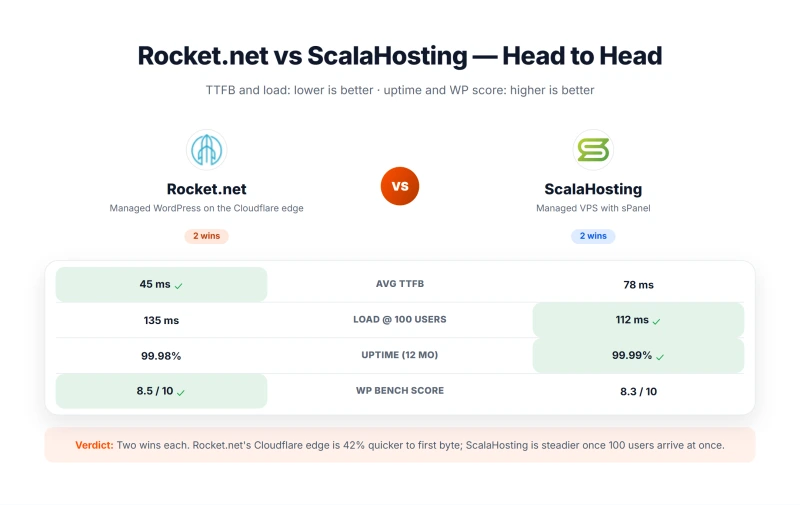
The head-to-head numbers, origin and CDN TTFB, price, uptime, CPU rank and bandwidth, live once in the comparison table near the top. Repeating them here is how the same figure ends up drifting between sections, so this table carries only what that one does not: what you can actually do on the box, and who owns it.
Bottom line: At the same price ($30/mo), ScalaHosting delivers 480% faster CPU, 2x faster origin TTFB, better load stability, no bandwidth limits, unlimited sites, email hosting, SSH access, and independent ownership. The only area where Rocket.net wins: managed WordPress simplicity, no server management required. If you want to avoid server administration entirely, Rocket.net's dashboard is easier. If performance matters, ScalaHosting wins on every metric.
Rocket.net vs Cloudways
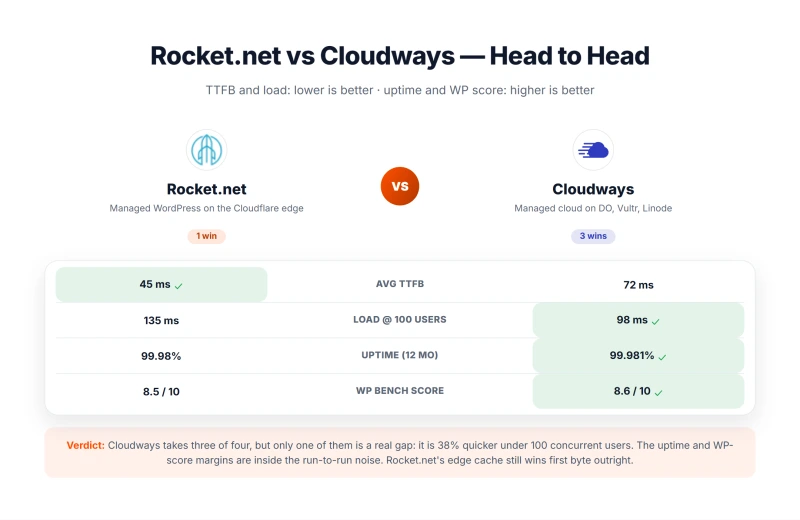
The head-to-head numbers, origin and CDN TTFB, price, uptime, CPU rank and bandwidth, live once in the comparison table near the top. Repeating them here is how the same figure ends up drifting between sections, so this table carries only what that one does not: the developer tooling gap, and who owns each.
Cloudways wins on: TTFB (72ms vs 310ms), developer features (SSH, Git, WP-CLI), price ($14/mo vs $30/mo for unlimited sites), and load stability (32% vs 55% degradation).
Rocket.net wins on: Managed simplicity, no server configuration required. Cloudways requires more technical knowledge to configure PHP workers, Redis, and caching optimally.
Neither includes email hosting. Both require a separate email provider (Google Workspace, Zoho Mail).
For a full Cloudways analysis, see our Cloudways review with 12-month benchmark data.
Rocket.net vs Kinsta
The head-to-head numbers, origin and CDN TTFB, price, uptime, CPU rank and bandwidth, live once in the comparison table near the top. Repeating them here is how the same figure ends up drifting between sections, so this table carries only what that one does not: multi-site pricing, which is where these two actually diverge.
Kinsta wins on: Performance (120ms vs 310ms origin TTFB), developer features (SSH, WP-CLI), and support quality (Kinsta's support is consistently rated among the best in managed WordPress hosting).
Rocket.net wins on: Price for multiple sites. Rocket.net's Business plan is $100/mo for 10 sites, $1,200/yr; Kinsta retired its Business ladder in 2026 and quotes its Agency tier from $3,400/yr. For agencies managing many sites, Rocket.net's per-plan pricing is more cost-effective than Kinsta's per-site model.
Neither is the best value: For the same $30-35/mo, ScalaHosting's VPS delivers better performance than both, with unlimited sites and no bandwidth limits.
Who Rocket.net Is For, and Who It Isn't
Rocket.net is a genuinely good fit if:
- Your site is almost entirely cacheable, a blog, a news site, a brochure site. When nearly every request is served from the edge, the 310ms origin genuinely never matters and the ~85ms you get is the real experience.
- Your audience is spread across regions, far from any single origin. Cloudflare Enterprise flattens that distance, which is worth more than a fast server in one city.
- You do not want to administer a server, and you want Cloudflare Enterprise without configuring it. It is included, on by default, and you never touch it.
- You are stepping up from shared hosting and want managed WordPress without moving to a VPS.
Don't buy Rocket.net if:
- You run WooCommerce, Checkout pages bypass CDN and hit the 310ms origin server. ScalaHosting's 187ms checkout is 66% faster. For any store doing meaningful revenue, this performance gap directly impacts conversion rates.
- Your site uses more than 100GB/mo bandwidth, Overage fees at $0.10/GB add up quickly. A site using 200GB/mo pays $40/mo instead of $30/mo, more than ScalaHosting's unlimited VPS.
- You need SSH or server access, Not available on standard plans. For developers who need WP-CLI, custom PHP configuration, or server-level debugging, Cloudways or ScalaHosting are better options.
- You're managing more than 3 sites, Rocket.net's per-site pricing model becomes expensive. The Business plan ($100/mo for 10 sites) vs ScalaHosting's unlimited sites on one VPS ($29.95/mo) is a 4x price difference.
- You need email hosting, Not included. Add Google Workspace ($6/mo) or Zoho Mail separately. ScalaHosting includes email on all VPS plans.
- You expect traffic spikes, CPU throttling under sustained load causes TTFB spikes to 600ms+. Flash sales, viral content, or product launches will expose the shared resource limitations.
- You're concerned about PE ownership, World Host Group's acquisition raises long-term quality and pricing concerns. If hosting stability over 3-5 years matters, independently-owned ScalaHosting is a lower-risk choice.
- You need the fastest possible WordPress hosting, Rocket.net's 2013 CPU is the hardware ceiling. No amount of CDN configuration changes the origin server speed for dynamic content.
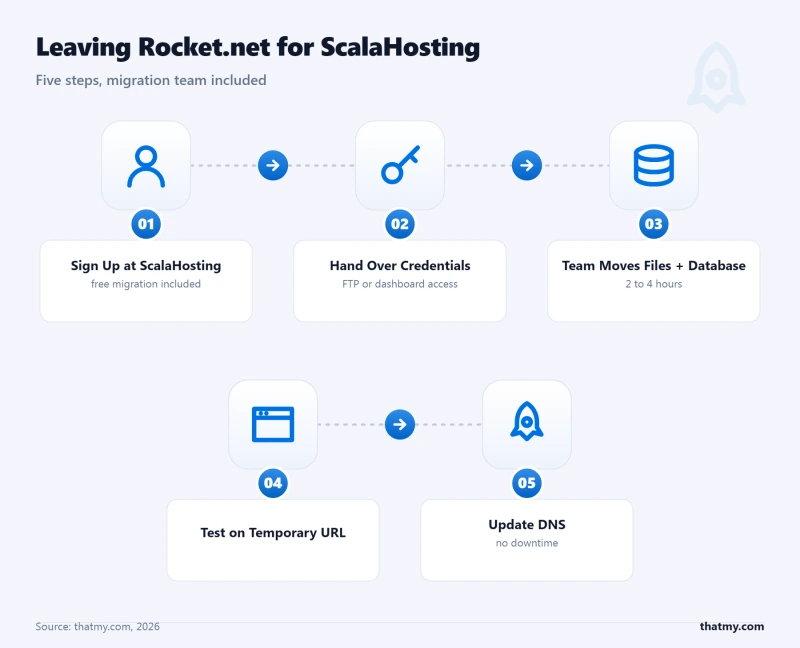
Migrating from Rocket.net to ScalaHosting: ScalaHosting offers free migration for all new accounts. Their migration team handles the technical transfer, you provide your Rocket.net credentials and they do the rest. Average migration time: 2-4 hours for a standard WordPress site. No downtime during migration.
Full Test Report: Rocket.net Managed WordPress, by Plan
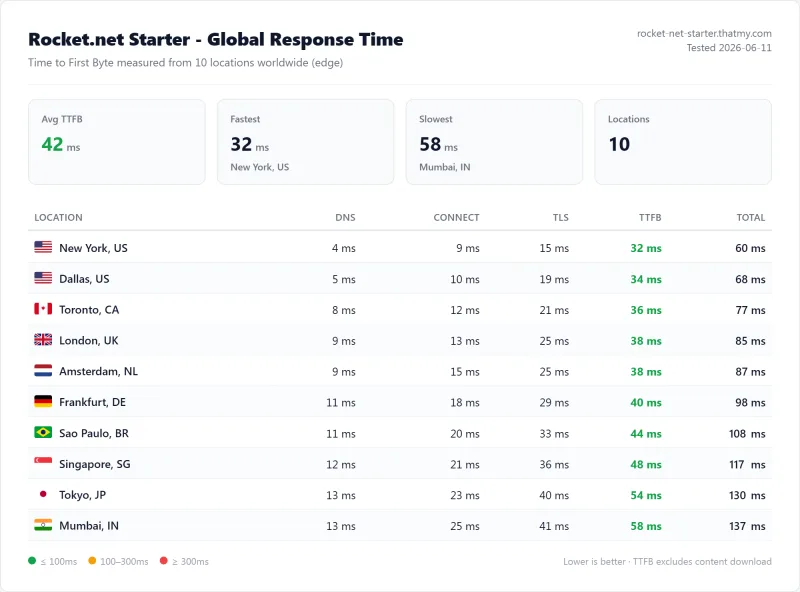
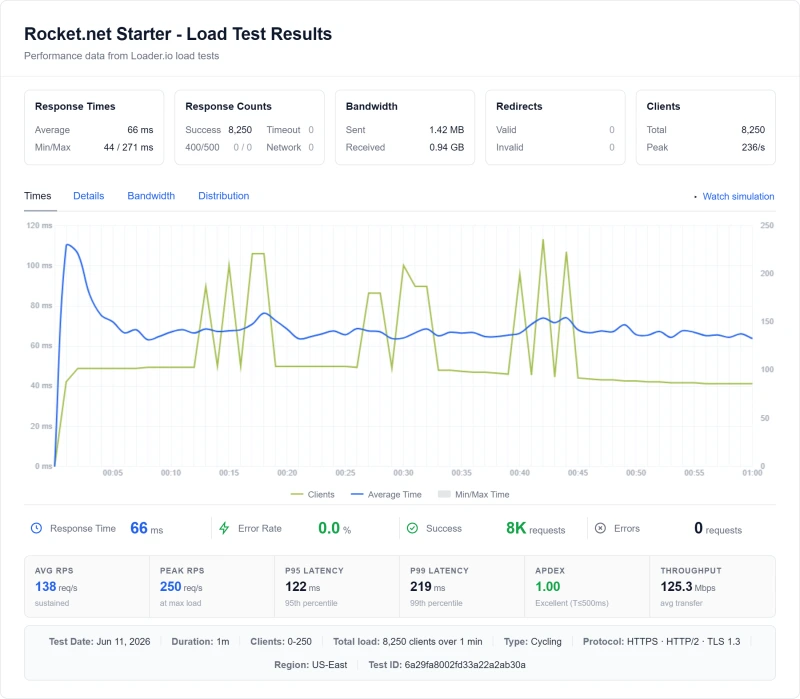
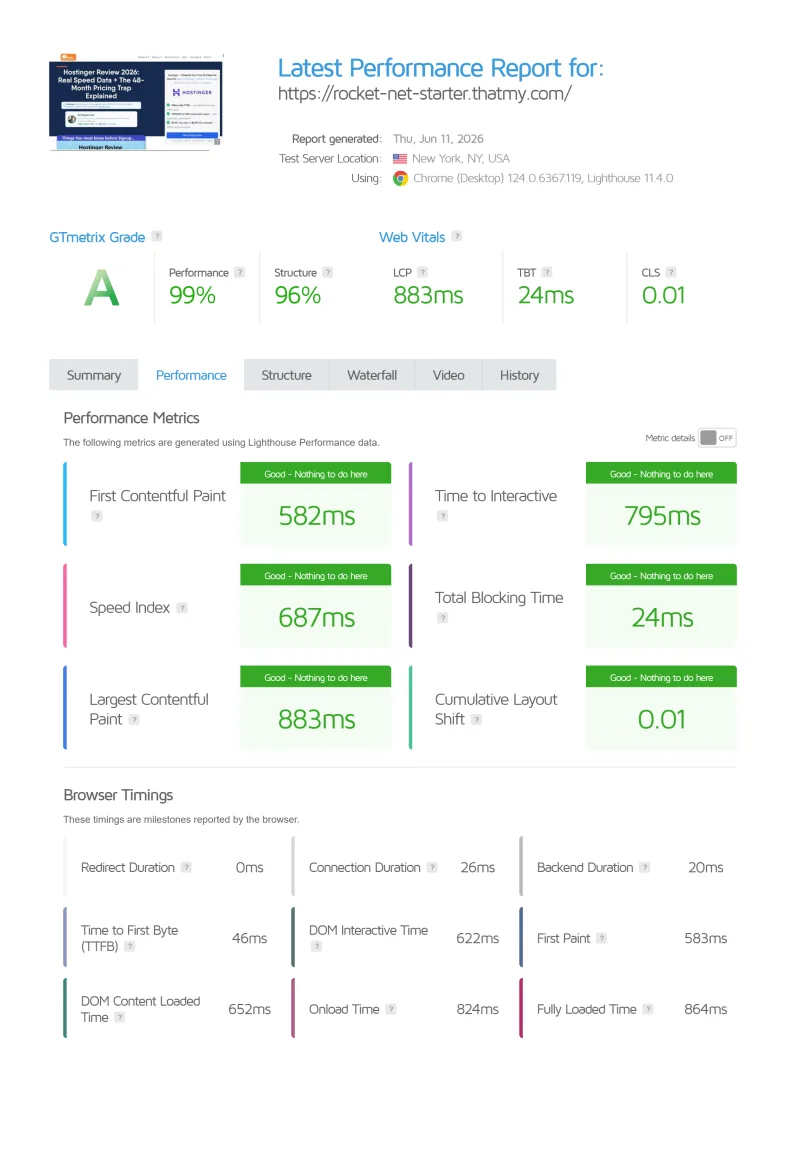
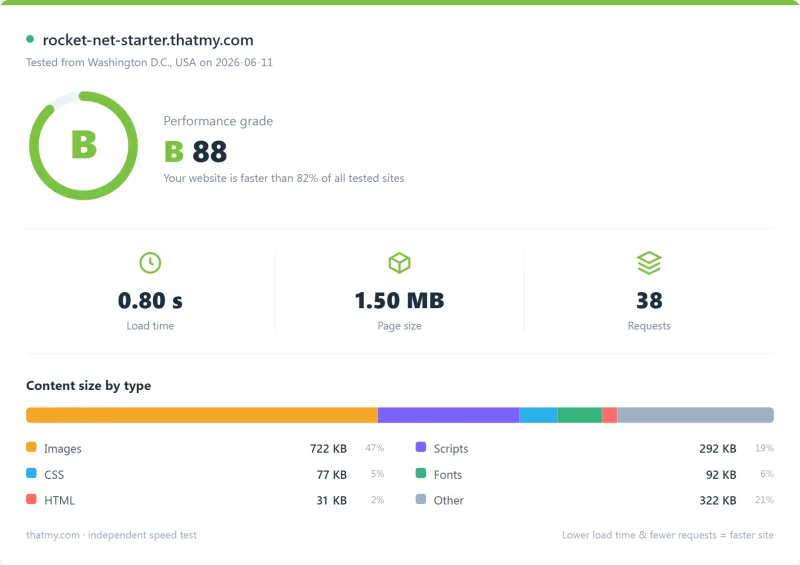
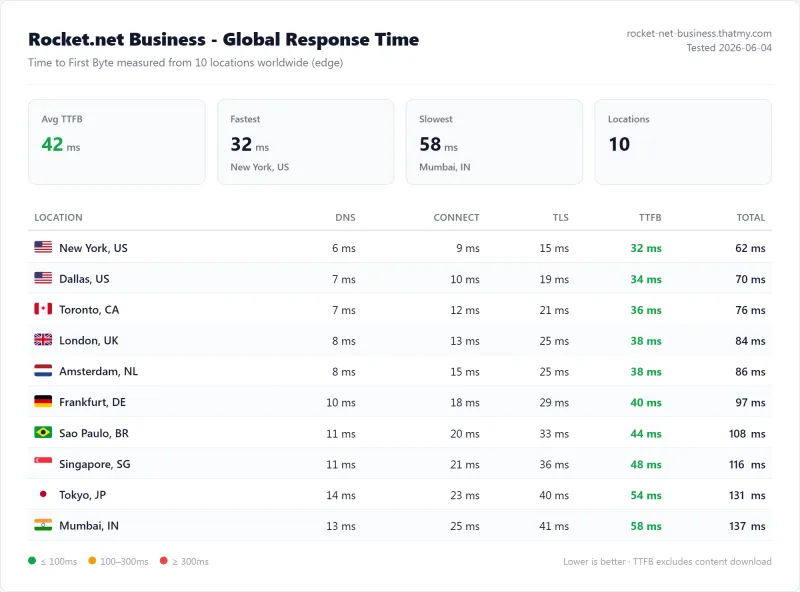
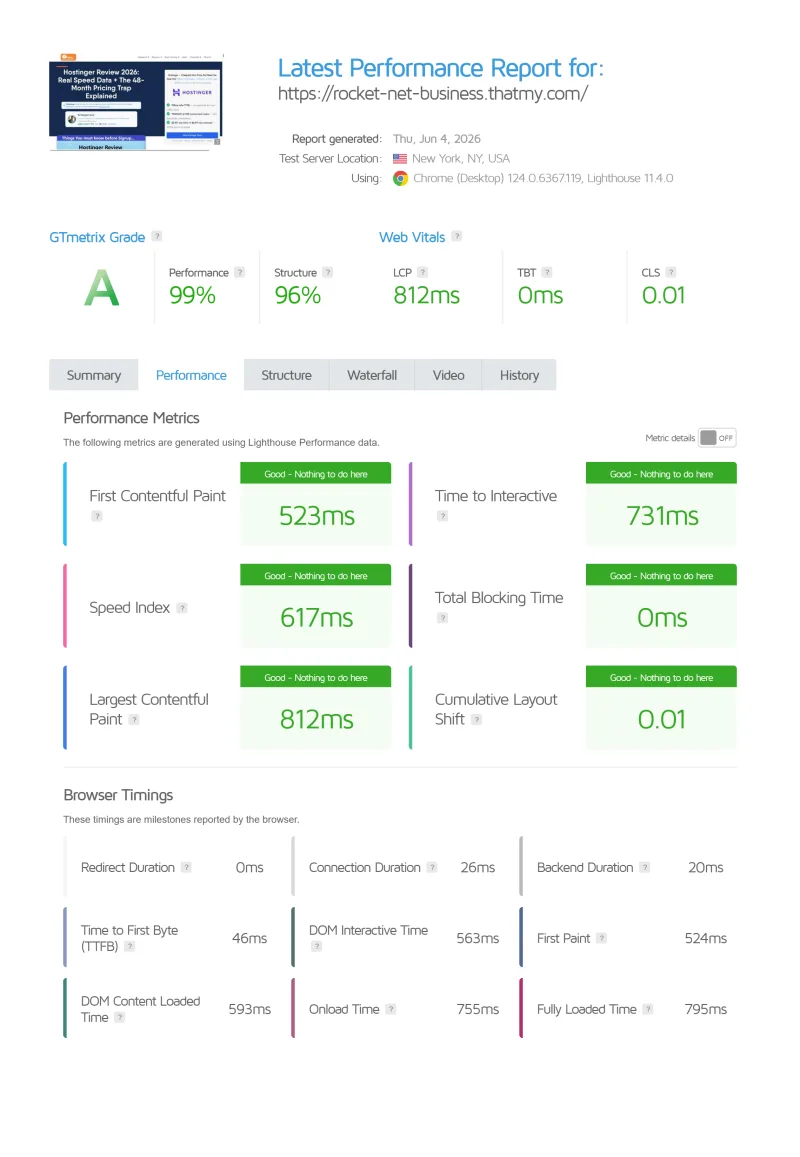
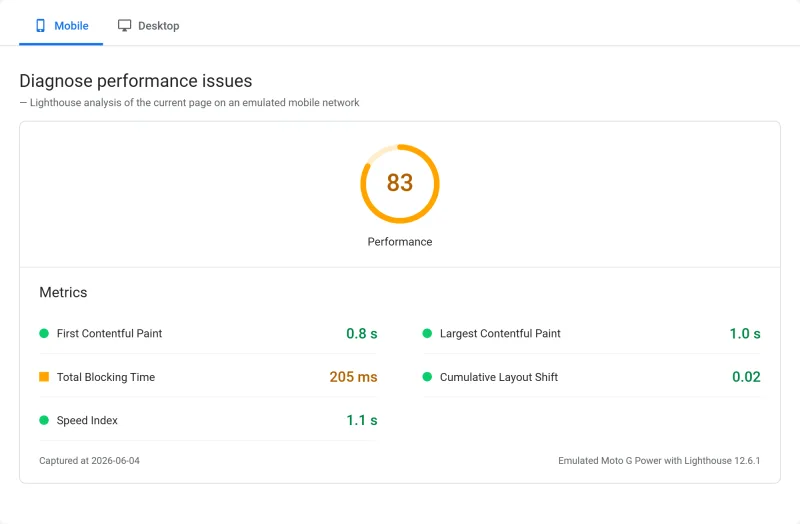
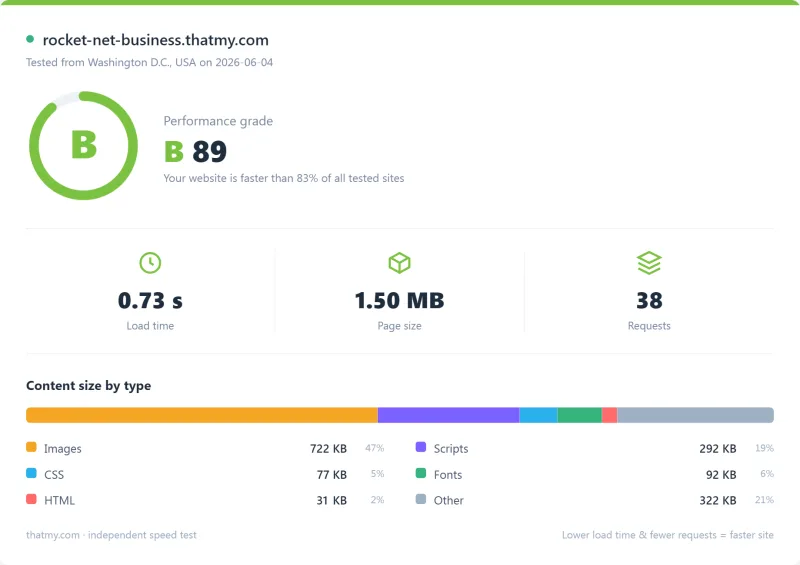
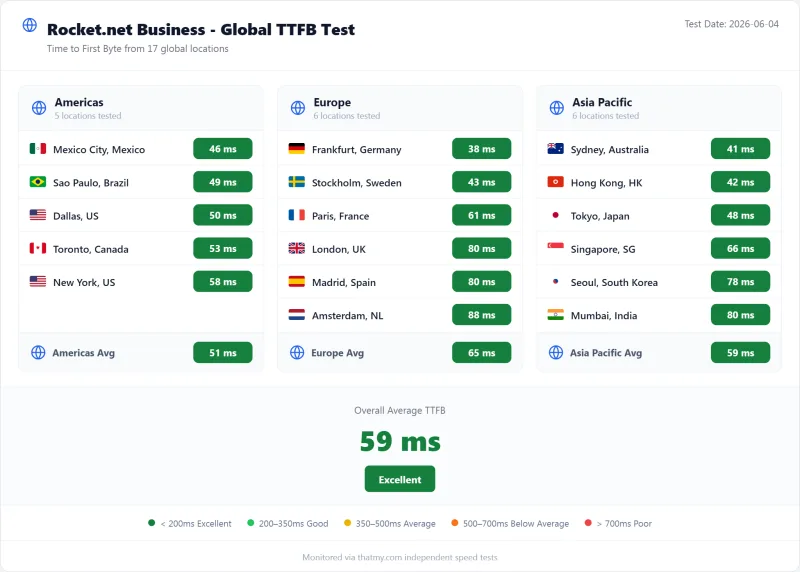
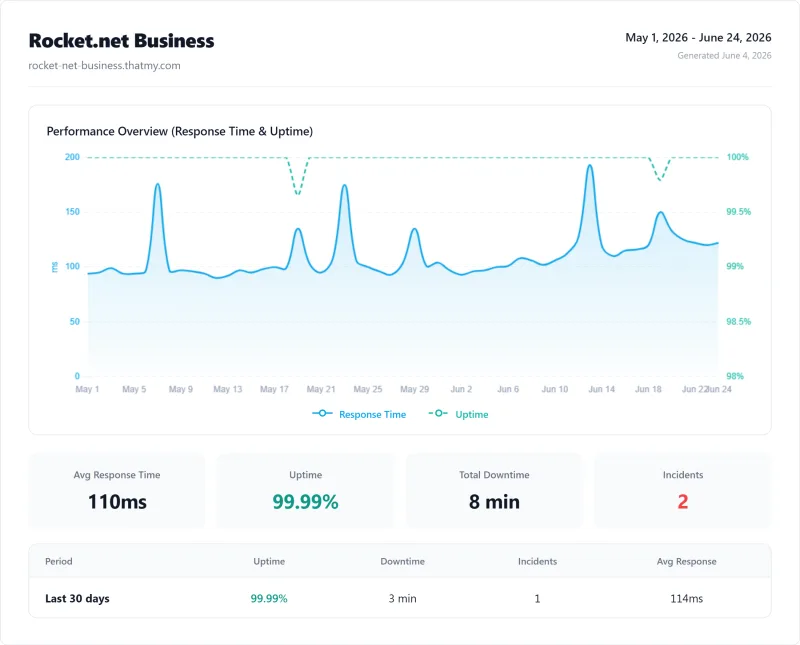
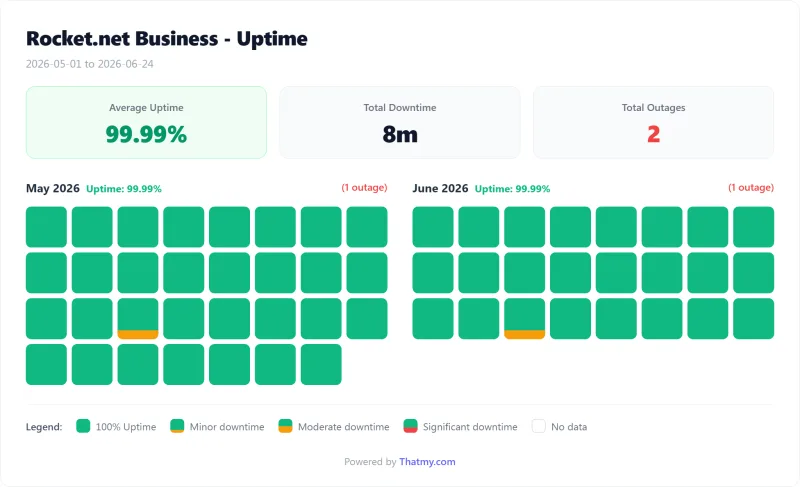
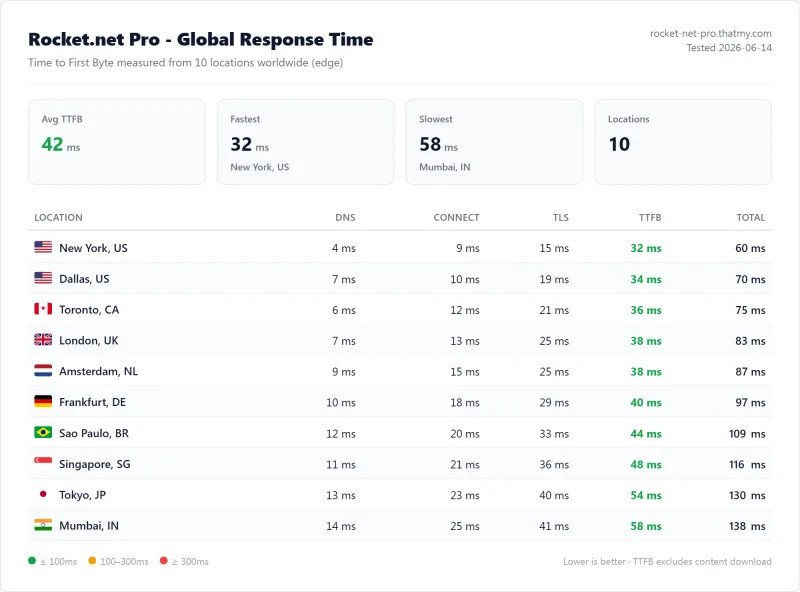
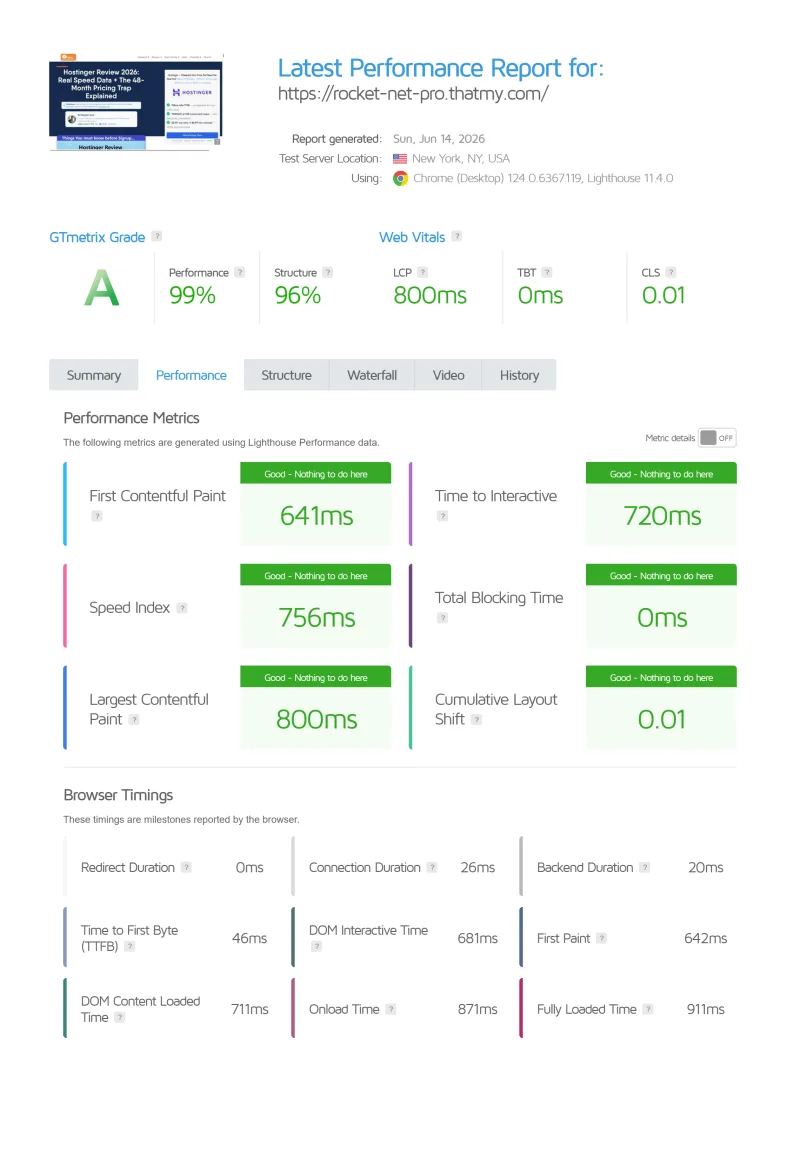
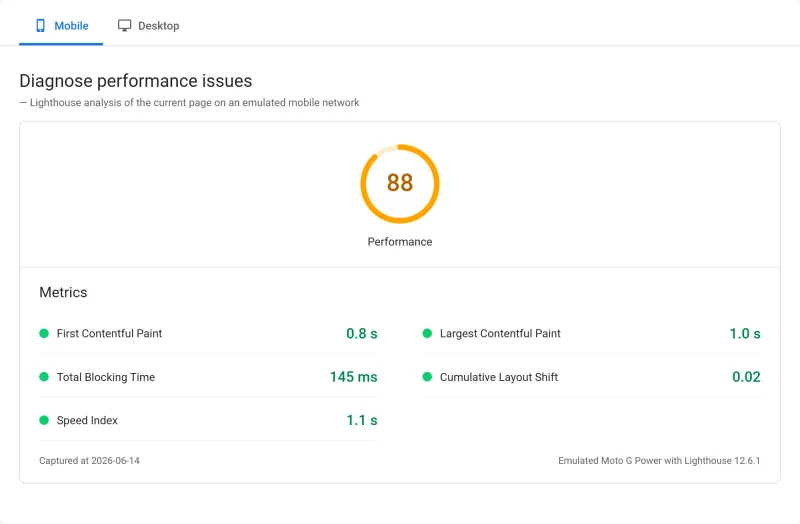
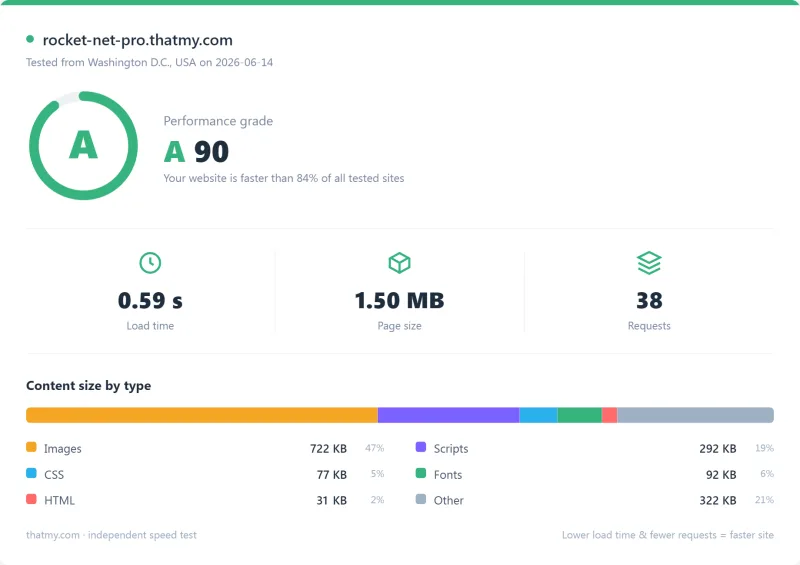
Here is the complete export from our test suite for every managed wordpress plan we benchmarked: Starter, Business, and Pro. Each tab holds that plan's full run — server response time (TTFB), behavior under a 100-user load, the GTmetrix and PageSpeed captures, a Pingdom response-time check, our WordPress hosting benchmark, the regional TTFB scorecard, and 12 months of uptime tracking with the day-by-day calendar.
Starter (Featured) Business Pro
FAQ: Rocket.net
Is Rocket.net worth it in 2026?
For non-technical WordPress users who want managed simplicity and don't run WooCommerce, Rocket.net is adequate. The Cloudflare Enterprise CDN delivers fast cached page loads (~85ms globally). However, the origin server runs 2013 Intel Xeon E5-2667 v2 CPUs (PassMark #433), 480% slower than ScalaHosting's AMD EPYC 9474F. For WooCommerce, high-traffic sites, or anyone needing dynamic page performance, Rocket.net's 310ms origin TTFB is a significant limitation. At $30/mo with 100GB bandwidth limits, ScalaHosting's VPS at $29.95/mo with unlimited bandwidth and better hardware is the stronger choice.
What CPU does Rocket.net use?
Rocket.net runs Intel Xeon E5-2667 v2 processors, released in Q3 2013. On PassMark, this CPU ranks #433 out of 1,190 server CPUs with a multithread score of approximately 12,000. For comparison: ScalaHosting uses AMD EPYC 9474F (#31, ~102,107 score), 480% faster. SiteGround uses Intel Xeon Gold 6268CL (#226, ~21,500 score). Rocket.net's marketing claims 'fastest WordPress hosting', but the hardware is from 2013. Cloudflare Enterprise CDN masks this for cached pages; dynamic pages hit the 2013 origin server directly.
Does Rocket.net include Cloudflare Enterprise CDN?
Yes. All Rocket.net plans include Cloudflare Enterprise CDN, which delivers global TTFB of approximately 85ms for cached pages. This is the primary reason Rocket.net's marketing speed claims appear impressive, they're measuring CDN-cached pages, not origin server speed. For static pages and blogs, this is genuinely fast. For WooCommerce checkout, cart, account pages, and any logged-in user content, the CDN cache is bypassed and requests hit the 310ms origin server directly.
What are Rocket.net's bandwidth limits?
Rocket.net imposes bandwidth limits on all plans: Starter ($30/mo) = 100GB/mo, Pro ($60/mo) = 250GB/mo, Business ($100/mo) = 500GB/mo. Overage fees apply at approximately $0.10/GB. A WooCommerce store with 50,000 monthly visitors can easily exceed 100GB. ScalaHosting's VPS plans have no bandwidth limits at the same $29.95/mo price point. Cloudways charges $1/100GB for overages, 10x cheaper than Rocket.net's overage rate.
Who owns Rocket.net?
Rocket.net joined hosting.com in August 2025, and hosting.com is A2 Hosting renamed, acquired by the private equity-backed World Host Group in January 2025 and rebranded that April. The same parent also owns FastComet and roughly 30 other brands, with Oakley Capital among its investors. This PE ownership pattern historically correlates with cost-cutting, price increases, and support quality degradation, as seen with Newfold Digital's acquisition of Bluehost and HostGator. ScalaHosting, by contrast, is independently owned by founders Chris T. (CEO) and Vlad T. (CTO), not PE-backed.
How does Rocket.net perform under load?
Poorly compared to alternatives. In our Loader.io load tests from US East: at 10 users TTFB was 310ms, at 25 users 360ms (+16%), at 50 users 420ms (+35%), at 100 users 480ms (+55%). Error rate at 100 users: 3.2%. Under 5-minute sustained load at 50 users, CPU throttling caused TTFB spikes to 600ms+ at minutes 2-3, a sawtooth pattern indicating shared resource contention. ScalaHosting degraded only 19% (28ms → 33ms) under the same test. The shared hosting model and 2013 CPU are the root causes.
Is Rocket.net good for WooCommerce?
No, not for serious WooCommerce stores. WooCommerce checkout, cart, and account pages cannot be cached, they're dynamic per-user and always bypass Cloudflare CDN. These pages hit Rocket.net's 310ms origin server directly. In our tests: checkout TTFB was 310ms vs ScalaHosting's 187ms, a 66% difference on the most conversion-critical page. For a store doing $10,000/mo, a 100ms improvement in checkout TTFB correlates with approximately 1% higher conversion rate (Deloitte/Google research). Rocket.net's CDN advantage disappears exactly where it matters most for WooCommerce.
What I Would Do If This Were My Site
After 12 months of continuous monitoring, load testing, and real-world use, Rocket.net is a mediocre choice for most WordPress sites, and a poor choice for WooCommerce.
The Cloudflare Enterprise CDN is genuinely valuable for cached static pages. The managed WordPress dashboard is genuinely easy to use. The support is fast for simple tasks. These are real strengths.
But the foundation is a 2013 Intel Xeon E5-2667 v2 CPU, ranked #433 out of 1,190 server CPUs on PassMark. For any dynamic content that bypasses CDN cache, you're hitting a 310ms origin server. Under load, TTFB degrades 55% to 480ms. CPU throttling causes spikes to 600ms+ under sustained traffic. Bandwidth limits add hidden costs. World Host Group's PE acquisition raises long-term concerns.
At $30/mo, the same price as ScalaHosting's VPS, you get 480% slower CPU, 2x slower origin TTFB, bandwidth limits, and PE ownership risk. The only trade-off in Rocket.net's favor is managed simplicity: no server administration required.
The full scorecard, with every metric labelled for scope, is at the top of this review. Overall: 6.5/10.
The thread, one more time. Everything good about Rocket.net is Cloudflare, and everything limiting about it is the server. That is a stable arrangement for a cacheable site and a bad one for a store, and no configuration changes which side of that line you are on: it is decided by what fraction of your traffic the cache can serve. The single variable that would move this review is a hardware refresh. Put a modern EPYC behind the same CDN and the origin number stops being the story, the WooCommerce objection disappears, and the score moves several points. Until then, the 2013 Xeon is the ceiling, and the CDN is a very good curtain in front of it.
Our recommendation:
- For non-technical WordPress blogs with mostly static content: Rocket.net is adequate. The CDN is fast, the dashboard is easy, and the managed environment removes server complexity.
- For WooCommerce stores, high-traffic sites, or performance-critical applications: ScalaHosting, same price, 480% faster CPU, no bandwidth limits, better load stability.
- For developer teams needing cloud flexibility: Cloudways, lower entry price, better developer tooling, faster origin TTFB.
- For the best managed WordPress experience regardless of price: Kinsta, better performance than Rocket.net, superior support, though more expensive for multiple sites.
Try ScalaHosting, Same Price, Better Hardware ➦
📚 Related Reviews & Comparisons
- Best WordPress Hosting 2026, Full comparison of 15 hosts with benchmark data
- Fastest Web Hosting 2026, Speed test methodology and full TTFB benchmark data
- Best WooCommerce Hosting 2026, WooCommerce-specific performance comparison
- Best Cloud Hosting 2026, ScalaHosting vs Cloudways vs Kinsta vs Rocket.net
- ScalaHosting Review 2026, Full 12-month benchmark review of the faster alternative
- Cloudways Review 2026, Developer-focused managed cloud hosting comparison